

The ROI of mentorship programs refers to the measurable business impact organizations gain by investing in structured mentoring relationships. While mentorship is often viewed as a cultural initiative, it also delivers tangible returns through improved retention, stronger leadership development, and increased employee engagement.
According to Gallup, employees who feel supported in their development are more engaged, and engaged employees are more productive and less likely to leave.
How Mentorship Programs Drive Measurable Results
1. Reduced Employee Turnover
One of the most significant drivers of the ROI of mentorship programs is reduced turnover.
Replacing an employee can cost anywhere from 50% to 200% of their annual salary, according to Society for Human Resource Management. Mentorship programs create stronger connections within organizations, helping employees feel supported and valued.
When employees see a clear path for growth, they are far more likely to stay.
2. Increased Employee Engagement
Mentorship programs directly impact engagement by creating meaningful relationships between employees.
Research from Gallup shows that employees who have access to development opportunities are significantly more engaged at work.
Engaged employees:
- Perform better
- Contribute more ideas
- Deliver stronger customer experiences
3. Stronger Leadership Development
Mentorship programs are one of the most effective ways to develop future leaders.
Instead of relying solely on formal training, mentorship provides real-world guidance, feedback, and knowledge transfer. This helps organizations build leadership pipelines internally rather than relying on costly external hires.
According to Association for Talent Development, companies that invest in employee development see higher performance and retention rates.
4. Improved Employee Productivity
Employees who receive mentorship often ramp up faster and perform more confidently in their roles.
Mentors help mentees:
- Avoid common mistakes
- Build skills more quickly
- Gain confidence in decision-making
This translates into measurable productivity gains across teams and departments.
A study highlighted by Harvard Business Review found that employees who receive mentoring are more likely to advance and perform at higher levels.
5. Enhanced Company Culture
The ROI of mentorship programs also includes cultural improvements that impact the entire organization.
Mentorship fosters:
- Collaboration across departments
- Stronger communication
- A sense of belonging
These factors contribute to a workplace where employees feel connected and invested in the company’s success.
How to Measure the ROI of Mentorship Programs
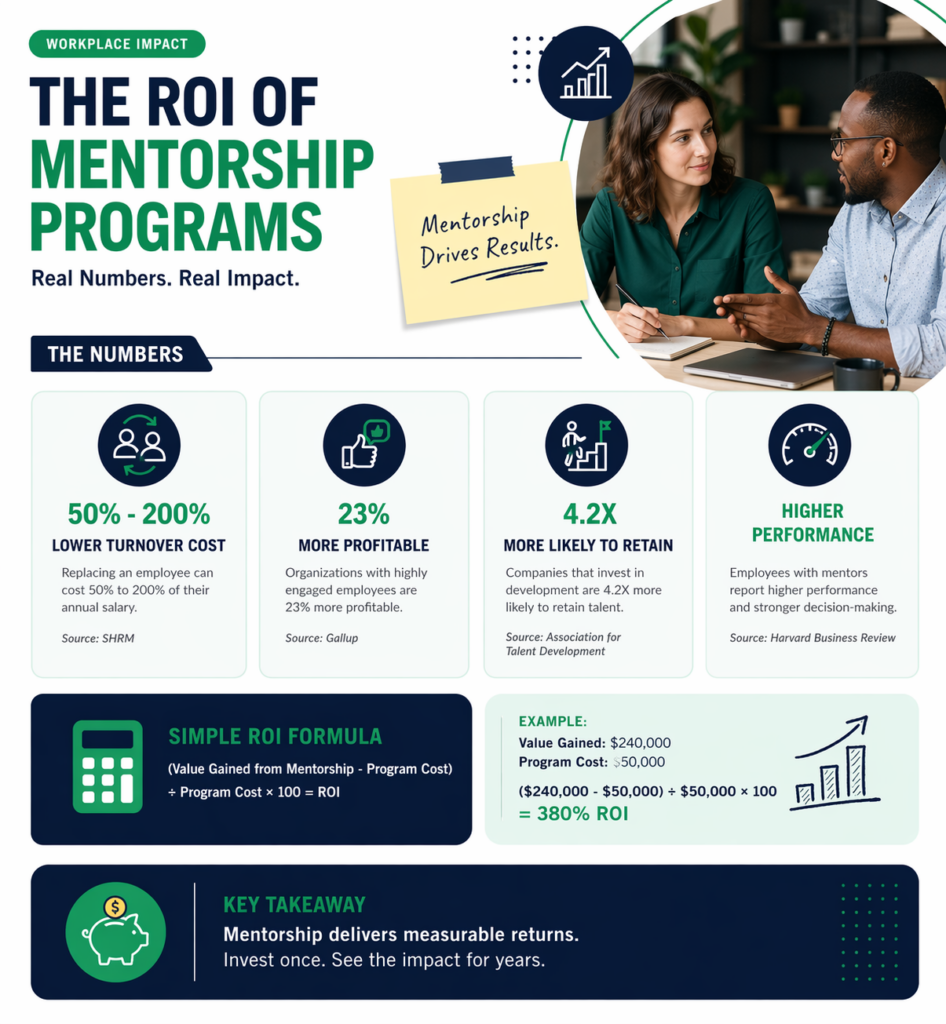
To fully understand the ROI of mentorship programs, organizations should track key metrics such as:
- Employee retention rates
- Engagement scores
- Promotion and internal mobility rates
- Training completion and development progress
- Employee satisfaction surveys
Modern platforms make it easier to track these metrics in real time and connect mentorship activity to business outcomes.
The Role of Technology in Maximizing ROI of Mentorship Programs
Many organizations struggle to measure the ROI of mentorship programs because their efforts are informal and unstructured.
Using a platform like FunFluence, part of the Fun Intended ecosystem, allows businesses to:
- Track mentorship participation and completion
- Measure engagement alongside mentoring activity
- Integrate mentorship with training and recognition
- Gain visibility into program effectiveness
By connecting mentorship to a broader employee engagement strategy, companies can clearly see the impact on retention and performance.
Why Mentorship Is a Strategic Investment
Mentorship is no longer just a “nice-to-have” initiative. It is a strategic investment that delivers measurable returns across the organization.
Companies that prioritize mentorship:
- Retain top talent
- Develop stronger leaders
- Improve employee performance
- Build a more engaged workforce
The ROI of mentorship programs becomes clear when organizations move from informal mentoring to structured, trackable systems.
Final Thoughts
The ROI of mentorship programs goes far beyond soft benefits. It directly impacts retention, engagement, productivity, and leadership development.
Organizations that invest in mentorship are investing in long-term growth and stability. With the right structure and tools in place, mentorship becomes one of the most valuable drivers of business success.