
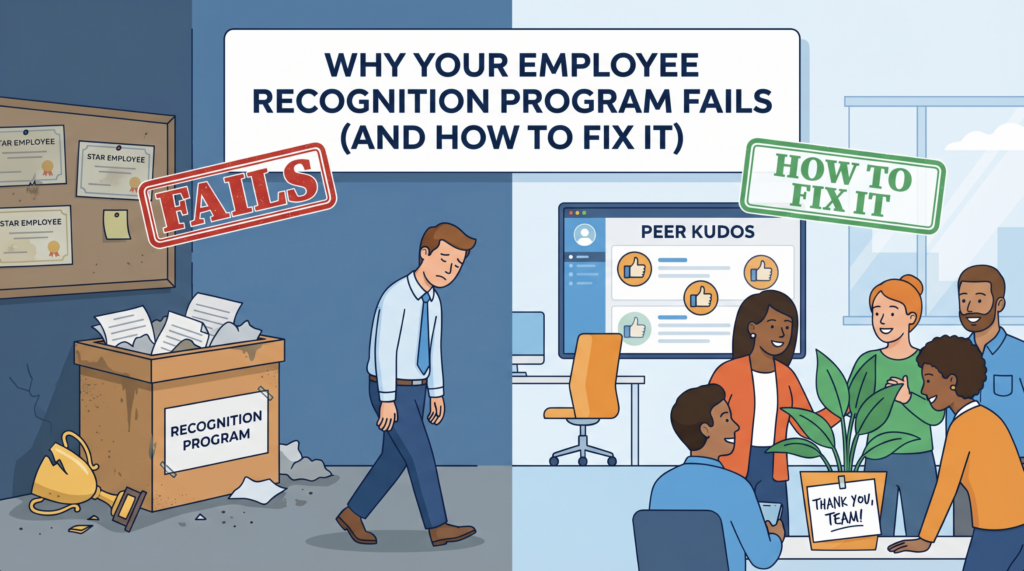
Roughly 80% of employers have some form of employee recognition program in place. So why do 65% of employees still say they don’t feel adequately recognized at work? Your employee recognition program fails because of the gap between design and execution.
That gap tells the whole story. Recognition spending in the US has ballooned into a $46 billion industry, yet the majority of employees feel invisible. The problem is rarely the budget. It’s the design, the execution, and the thinking behind the program itself.
If you’ve launched a recognition initiative and found yourself wondering why nobody seems engaged with it, you’re in good company. Here’s an honest look at where these programs break down and what you can do to build something that actually works.
The Most Common Reasons Why Your Employee Recognition Program Fails
1. Recognition Is Treated as a Top-Down Responsibility
Most programs are built around managers recognizing employees. On paper, that makes sense. In practice, managers are often stretched thin, dealing with scheduling gaps, customer issues, and a dozen other priorities. When recognition depends entirely on a manager noticing and acting, it becomes inconsistent at best and nonexistent at worst.
Employees end up feeling like their daily contributions go unseen, because no single person can see everything. Research shows that only 22% of individual contributors strongly agree they receive the right amount of recognition for their work, and a large part of that shortfall is the bottleneck created by manager-only systems.
The fix is decentralization. When peers can recognize each other, recognition happens in real time, close to the moment it matters. Companies with peer-to-peer recognition programs see 26% higher employee engagement than those without, and employees with strong peer connections are 4.7 times more likely to feel appreciated and engaged at work.
2. The Recognition Feels Generic
“Great job this week!” sounds nice. It means almost nothing. When recognition lacks specifics, it communicates that the person doing the recognizing wasn’t really paying attention. Employees notice that. Over time, a stream of vague praise starts to feel like a checkbox exercise rather than genuine appreciation.
Effective recognition names the specific behavior, explains why it mattered, and connects it to something larger. “You stayed on top of every customer follow-up this week even when the queue was overwhelming, and three clients mentioned it in their feedback surveys” does something entirely different than a generic thumbs up. It tells the employee exactly what they did right, why it was valuable, and what to keep doing.
This level of specificity also reinforces the behaviors you actually want to see repeated, which turns recognition from a morale gesture into a performance tool.
3. There’s No Connection to Values or Goals
When recognition exists in a vacuum, it loses its cultural weight. If a company talks about accountability, collaboration, and customer care in all-hands meetings, but the recognition program never mentions those values, employees receive a mixed message. What does leadership actually care about?
Recognition programs that don’t align with company culture and values feel disingenuous to employees, and disengagement follows. When you tie recognition directly to core values, something changes. People start to see the values as real, not aspirational talking points. Culture stops being a slide deck and starts being a lived daily experience.
This is one reason Fun Intended’s FunEngaged platform is built around connecting recognition to the outcomes that matter most to each individual organization. Recognition becomes part of how the company communicates what it stands for.
4. The Program Has No Visibility
A recognition that happens in a private email or a manager’s one-on-one note is appreciated by one person. A recognition that happens publicly in front of the team does something different: it signals to everyone that this kind of contribution gets noticed.
85% of employees prefer public recognition because it boosts morale not just for the person being recognized, but for everyone who sees it. Public recognition creates a culture effect. When people watch their colleagues get acknowledged for going above and beyond, they internalize that it’s worth doing the same.
If your recognition program lives in a private system or gets buried in a notification nobody checks, its impact is a fraction of what it could be.
5. It Only Celebrates Big, Infrequent Wins
The classic “Employee of the Month” model has a structural problem. It rewards one person, usually for a large achievement, on a monthly cycle. Everyone else goes unrecognized for 29 days straight. And the moment you know you’ve already “missed” this month’s award, there’s very little motivation to go above and beyond for the rest of the cycle.
Frequent, timely recognition is far more effective than rare, grand gestures. Employees who receive recognition at least once a week are five times more likely to be highly engaged. The recency matters too. Recognition that lands closest to the moment of the achievement reinforces the behavior most powerfully.
6. Nobody Is Measuring Whether It’s Working
Only 43% of organizations regularly review their recognition program’s effectiveness, and only 33% take employee feedback into high consideration when refining it. That means most companies are running recognition programs on autopilot with no real sense of whether they’re changing anything.
A recognition program that isn’t measured can’t be improved. Participation rates, recognition frequency, engagement scores, and retention data all tell a story about whether your program is landing. Without that data, you’re guessing.
What Happens When Your Employee Recognition Program Fails
The stakes here are higher than morale. 66% of employees say they would leave their jobs if they didn’t feel appreciated, making lack of recognition one of the leading drivers of voluntary turnover. On the flip side, employees who receive high-quality recognition are 45% less likely to leave their organization over a two-year period and 65% less likely to be actively seeking other opportunities.
That is a retention lever that costs a fraction of what a recruiting cycle does. For organizations in high-turnover industries like call centers, healthcare, and retail, getting recognition right can be the difference between a stable workforce and a revolving door.
We saw exactly this play out with TAS United, a Texas-based call center that reduced its turnover rate by 82% in 12 months after implementing a comprehensive engagement strategy that included a structured rewards and recognition program. The recognition platform didn’t just make people feel good. It rebuilt trust, reinforced performance, and became a foundation for everything else. You can read the full TAS United employee engagement case study here.
What a Recognition Program That Actually Works Looks Like
The organizations that get recognition right have a few things in common.
They make it frequent and timely, catching people doing something right close to the moment it happens rather than waiting for a quarterly review. The business makes it specific, naming the exact behavior and explaining why it mattered. They make it visible, so the cultural signal reaches the whole team and not just the individual. They connect it to company values, so recognition reinforces the kind of workplace they’re actually trying to build. And they build in peer-to-peer recognition so the program doesn’t collapse whenever a manager is busy or distracted.
Companies with strong recognition programs see a 31% lower voluntary turnover rate and a 92% engagement rate. Those numbers don’t happen by accident. They happen when recognition is designed thoughtfully, supported by the right tools, and treated as a strategic priority rather than an HR checkbox.
The Role of Mentorship and Development in Recognition
One dimension of recognition that often gets overlooked is the connection between being appreciated and being invested in. When employees feel recognized for their growth and not just their output, it creates a different kind of loyalty.
Fun Intended’s FunFluence mentorship program is built around this idea. Pairing employees with mentors sends a clear message: we see potential in you and we’re willing to invest in it. That is a form of recognition that compounds over time, building both the skills and the commitment of the people it touches.
Pairing mentorship with a formal recognition platform creates a system where employees feel seen for who they are becoming, not just what they delivered last week.
Where to Start
If you suspect your employee recognition program fails, a good first step is an honest audit. Ask your team whether they feel genuinely recognized. Look at your participation rates. Check whether your program is built for manager-only recognition or whether it enables peer-to-peer appreciation. Find out if recognition is tied to your core values or floating free of any cultural context.
If what you find points to gaps, that’s not a failure. It’s data. And data is what Fun Intended’s employee engagement consulting is designed to help you act on, building programs that connect recognition to the real drivers of retention, performance, and culture.
The goal isn’t to run a recognition program. The goal is to build a workplace where people feel genuinely valued for showing up and doing great work. When that happens, everything else gets easier.
Ready to rethink your approach to recognition? Explore Fun Intended’s rewards and recognition tools or get in touch to start a conversation about what a better program could look like for your organization.