
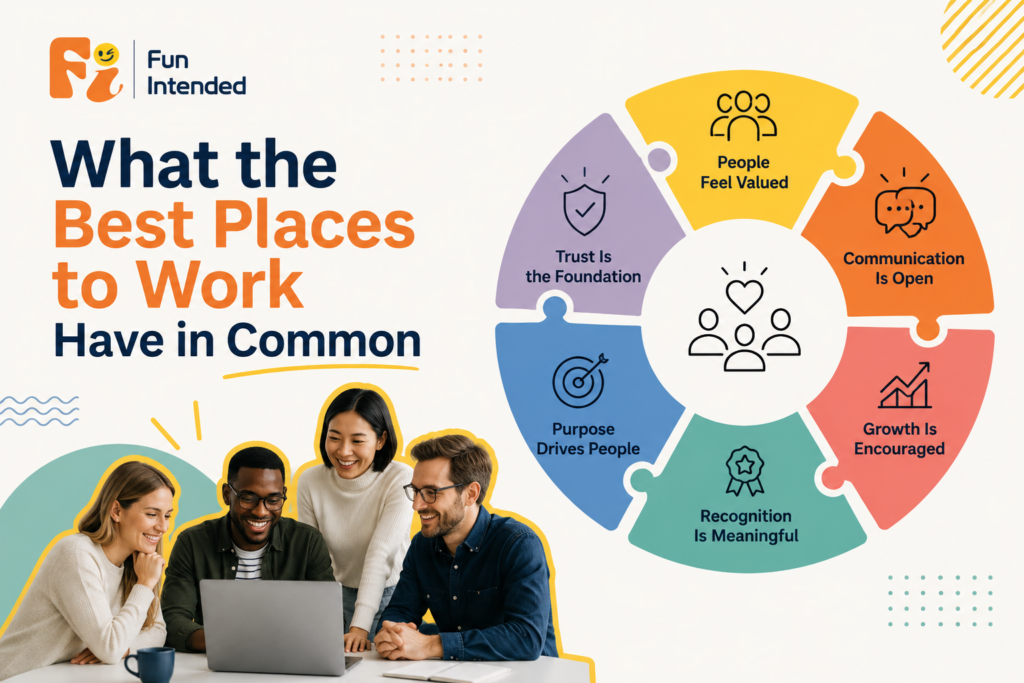
Every year, lists of the best places to work get published, studied, and shared. The names on them tend to be impressive. But the more useful question is not who made the list. It is why.
What do the organizations that consistently land on these rankings actually do differently? And more importantly, is it something that only well-resourced companies can replicate, or is it something any organization can build regardless of size, industry, or budget?
The research has a clear answer. Great Place to Work has surveyed more than 100 million employees across 30 years of research and identified trust, pride, and camaraderie as the three defining characteristics of a great workplace. None of those things require a sprawling campus or a kombucha bar. They require intentional leadership, consistent behavior, and a genuine commitment to the people who show up every day.
Here is what the best places to work have in common, and what it actually looks like to build those things from the ground up.
The Best Places to Work Have Made Trust the Foundation, Not a Talking Point
If there is one variable that separates the best workplaces from everyone else, it is trust.
Companies on the Fortune 100 Best Companies to Work For list earn 8.5 times more revenue per employee than the U.S. public market average. They have also achieved a cumulative 27-year stock return of 3,174%, compared to 907% for the Russell 1000 Index over the same period. These are not soft benefits. They are financial outcomes, and they trace directly back to how employees experience the culture those companies have built.
High-trust companies see 8.5x greater revenue per employee than the U.S. public market average, and employees at high-trust workplaces are 45% more likely to say their workplace celebrates innovation and trying new things regardless of the outcome. Trust is not a culture initiative. It is the engine that makes every other initiative work.
What does trust actually look like in practice? Great Place to Work’s research identifies three dimensions: credibility, which is whether employees see management as honest and competent; respect, which is whether employees feel supported and genuinely cared about; and fairness, which is whether opportunities and recognition are distributed equitably. When all three are present consistently, employees invest in the organization. When any one of them slips, the whole foundation starts to crack.
83% of employees at the Fortune 100 Best Companies say management’s actions match its words. That single statistic explains a lot. Trust is built in the gap between what leaders say and what they actually do. The best workplaces close that gap.
They Recognize People Often, Specifically, and Publicly
Compensation matters. But when employees are proud of their work, they are 20 times more likely to say they have a great workplace than when they are simply paid fairly. That is not an argument against competitive pay. It is an argument for understanding what truly drives the experience employees describe when they call somewhere a great place to work.
Recognition is one of the most powerful and most underutilized levers in that experience. The best workplaces have figured out that recognition needs to be three things to actually land: frequent, specific, and visible.
Frequent means it happens close to the moment it is earned, not once a quarter during a review or once a year at an awards dinner. Specific means it names the exact behavior and explains why it mattered, rather than offering a vague “great job.” Visible means it happens where others can see it, because public recognition changes not just how the recognized person feels but how the whole team understands what is valued.
Great Place to Work research identifies regular employee appreciation as one of the nine core leadership behaviors that build high-trust cultures. It is not a perk. It is a trust mechanism. And organizations that build structured, consistent recognition into their culture see measurable differences in engagement, retention, and performance.
A platform like Fun Intended’s Fun Rewards program is built around exactly this model: peer-to-peer visibility, recognition tied to company values, and a rhythm frequent enough that employees actually feel seen rather than occasionally praised.
The Best Places to Work Invest in People’s Growth
The best places to work treat development as a retention strategy, not a training budget line item.
Career growth is consistently identified as the number one reason employees stay at a company, and the organizations that show up on best workplace lists year after year have built infrastructure around that reality. That means structured learning pathways, clear career frameworks, manager training, and mentorship relationships that connect employees to people who can help them grow.
What distinguishes the best workplaces is not just that these programs exist. It is that employees believe they are real. The frameworks are documented. The development conversations are regular and substantive. The mentors are equipped to actually guide growth, not just check a box. And internal mobility is treated as a success, not a threat to a manager’s headcount.
Great Place to Work research highlights that helping employees grow personally and professionally is one of the nine behaviors that most directly shape the level of trust in an organization. Leaders who connect employees to mentors, provide structured learning opportunities, and give feedback in a way that is both measurable and caring build something that outperforms any perk package.
For organizations looking to build this infrastructure, The Fun Train LMS and FunFluence mentorship program are designed to work together as a connected development system, giving employees both the structured learning pathways and the paired human guidance that makes growth feel real.
They Communicate With Transparency and Consistency
One of the most common threads in employee feedback from recognized best workplaces is trust in communication. Employees know what is happening in the organization, why decisions are being made, and how their work connects to something larger. They do not find out about major changes through rumors or all-hands meetings that feel like announcements rather than conversations.
Leaders at great workplaces provide information honestly and transparently, are accessible, and actively seek employee input. That last part is worth sitting with. The best workplaces are not just good at broadcasting information downward. They are good at genuinely listening and visibly acting on what they hear.
This is harder than it sounds. It requires communication infrastructure: regular cadences, feedback channels that monitored, and a leadership culture where surfacing problems welcomed rather than quietly discouraged. And it requires follow-through. When employees share concerns and see nothing change, they stop sharing. When they share concerns and see leadership respond, trust deepens.
The transformation Fun Intended led at TAS United built on this foundation. A monthly newsletter, structured communication channels between leadership and frontline employees, and a digital suggestion box where leadership acted on employee feedback were not peripheral elements of the strategy. They were central to it. The full TAS United case study illustrates how those communication investments directly contributed to an 82-percentage-point drop in turnover over 12 months.
The Best Places to Work Build a Culture of Belonging and Shared Purpose
The best workplaces are not collections of individuals doing jobs. They are communities of people who feel connected to each other and to something larger than their own role.
Psychological safety is a defining trait of companies recognized on best workplace lists. Companies on the 2026 Fortune 100 Best list report significantly higher levels of psychological and emotional health at 81%, compared to 56% at a typical U.S. workplace. When people feel safe, they are 44% more likely to feel confident in their leaders and more than twice as likely to stay with the company.
The way new employees are onboarded, peers recognize each other, managers show up in one-on-ones, as well as leadership responds to difficult questions in town halls builds a sense of safety and belonging. Culture is not a poster on a wall. It is the cumulative experience of all of those moments over time.
The organizations on best workplace lists have understood this long enough to build systems around it. Recognition reinforces belonging. Career pathing reinforces investment. Mentorship reinforces care. Communication reinforces trust. None of these things work in isolation. They work together as a culture ecosystem, and the best workplaces have intentionally designed that ecosystem rather than letting it emerge by accident.
They Measure and Act on Engagement
One last thing the best workplaces have in common: they do not guess about how their employees feel.
They run structured engagement programs, listen to the results, and make changes that employees can actually see. They use real-time data to catch disengagement early rather than waiting for exit interviews to tell them what went wrong. And when survey scores decline or feedback surfaces a problem, leadership treats that as signal worth acting on, not noise to manage.
Great Place to Work has found that companies that score in the top 25% on employee experience report double the return on sales compared to lower-performing companies. The measurement matters not because data is the goal but because you cannot improve what you do not track.
Any Company Can Get Here
The traits that define the best places to work are available to any organization willing to build them deliberately.
That means investing in recognition infrastructure so appreciation is visible and consistent. It means creating career frameworks and development programs that give employees a reason to stay. It means building communication habits that close the gap between what leadership says and what employees experience. And it means measuring engagement in ways that catch problems before they become departures.
None of it happens overnight. But the organizations that commit to this work consistently outperform those that treat culture as a secondary concern. The data on that has been consistent for three decades.
If you want to understand where your organization stands today and what it would take to build a culture that keeps its best people, Fun Intended’s employee engagement consulting is a good place to start that conversation.
Ready to start building a workplace your employees would be proud to talk about? Get in touch with Fun Intended and let’s talk about what that looks like for your organization.