
If you’ve ever taken your family to Disney World, you’re probably familiar with the “park hopper” ticket option. This ticket lets you start the day in one park and “hop” to another in the afternoon. You can even hop to multiple parks until closing time.
On paper, this sounds amazing. More parks, more rides, more fun. But most people forget one important thing: the time spent traveling between parks. You can’t just ask Mary Poppins to take you to a new park through a chalk drawing on the sidewalk. You hop a bus, ride the monorail, or take the Skyliner (my personal favorite). No matter which option you choose, a significant portion of your day is spent in transit. This is time you could’ve spent experiencing attractions in the original park.

The Myth of Multitasking and Why It Reduces Productivity
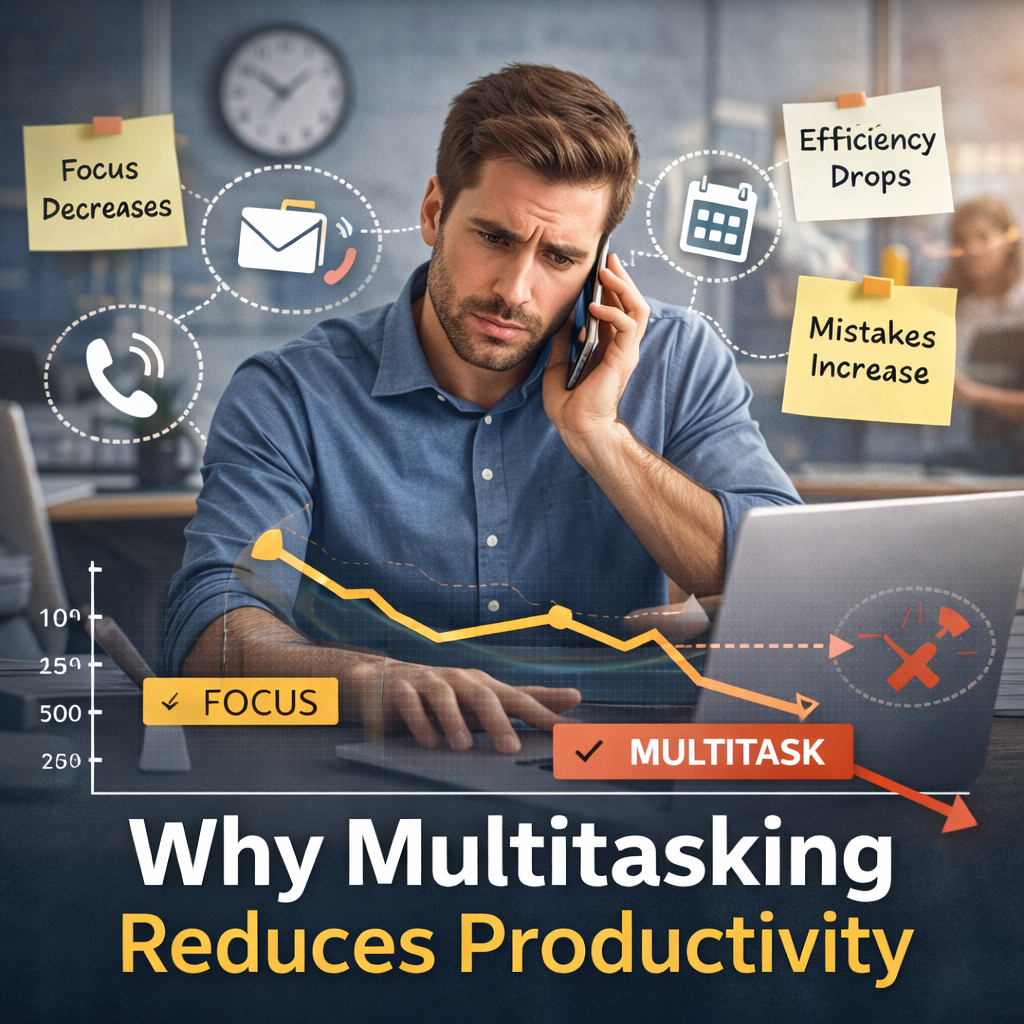
Multitasking sounds productive in theory. Who wouldn’t want to “do it all” at once? Unfortunately, the reality is very different. Switching from one project to another may feel like progress, but it often creates more waste than results.
Research consistently shows that constantly switching tasks comes with a cognitive cost:
- The American Psychological Association reports that multitasking reduces productivity by up to 40% compared with focusing on a single task.
- Studies have found that after an interruption, it can take as long as 23 minutes for the brain to return to peak focus.
Every time you switch tasks, your brain experiences a “reset” period. You lose not only time, but mental clarity and momentum. Those seconds and minutes add up fast, leading to increased stress, missed deadlines, and incomplete work.
What Happens When You Focus on One Task at a Time
When employees prioritize finishing one project before starting the next, the whole team benefits. Work becomes more organized, priorities are clearer, and progress is easier to measure. This focused approach boosts both efficiency and confidence.
Structured development through a learning management system platform also helps employees focus on one skill at a time instead of juggling competing priorities.
A few key benefits of single-tasking include:
1. Fewer errors
Studies show that task switching increases the likelihood of mistakes because attention is fragmented and cognitive load becomes heavier.
2. Faster task completion overall
Despite the common belief that multitasking saves time, research shows it actually reduces productivity. Focusing on a single task from start to finish consistently leads to faster and higher-quality outcomes.
3. Better performance on complex tasks
Tasks requiring deeper thinking or creativity suffer most from attempts to juggle multiple priorities simultaneously. Focus allows for deeper processing and higher-quality work.
How Focus Impacts Team Performance and Organizational KPIs
Focus directly impacts business outcomes. Metrics such as:
- Project completion rates
- Client satisfaction scores
- Employee engagement
- Team morale
- On-time delivery
All improve when individuals and teams reduce unnecessary task switching. Clear goals and visible progress help employees stay focused, which is why tools like an employee gamification platform can reinforce attention and accountability.
According to Harvard Business Review, people who practice focused work are more likely to:
- Meet deadlines
- Produce higher-quality work
- Report better job satisfaction compared to employees who multitask regularly.
The overall takeaway: Better focus leads to better outcomes. It’s that simple.
The Leader’s Role in Fostering Focus
Leaders play a vital role in setting the tone for focused work habits. It starts with expectations, workflows, and team culture.
Many organizations use employee engagement consulting to redesign workflows and reduce the constant context switching that hurts productivity.
Here’s how leaders can build a focus-friendly environment:
Set clear priorities
Teams work best when they know what matters most. When priorities are blurred, focus becomes impossible.
Encourage single-tasking over multitasking
Avoid assigning multiple high-priority tasks simultaneously. Encourage employees to complete one project before moving to the next.
Build realistic schedules and deadlines
Unrealistic expectations almost always push teams into fragmented work patterns. Leaders should model focused work.
Celebrate focus and outcomes
Reinforce wins when employees finish strong. Focus isn’t just about staying busy. It’s about impact and completion.
When leaders champion focus as a habit rather than a suggestion, teams reinforce better productivity naturally.
Turning Focus Into a Culture (and Saving Time Along the Way)

Going back to our Disney analogy…Imagine spending your day riding attractions instead of boarding buses or waiting in line to take the Skyliner. That’s the upside of focus. It creates more time in the moments that matter.
In real work, this might look like:
- Blocking dedicated focus time on calendars
- Limiting unnecessary context switching
- Setting email and message check-ins instead of constant interruptions
- Encouraging task completion rituals
All of these practices help reduce wasted time and allow teams to spend more energy on meaningful work.
Work Better, Not Busier
Multitasking is a tempting myth. It promises more done in less time. But like the park hopper ticket, it often costs you more than you realize.
By focusing on one task at a time, employees not only improve productivity but also create clearer results and a less stressful work experience. Leaders who champion focus help their teams work smarter, produce better outcomes, and feel more confident and engaged in their roles.
So grab a Dole Whip or a Mickey pretzel and enjoy the ride. Work can be productive and fulfilling when you give your attention where it belongs.