
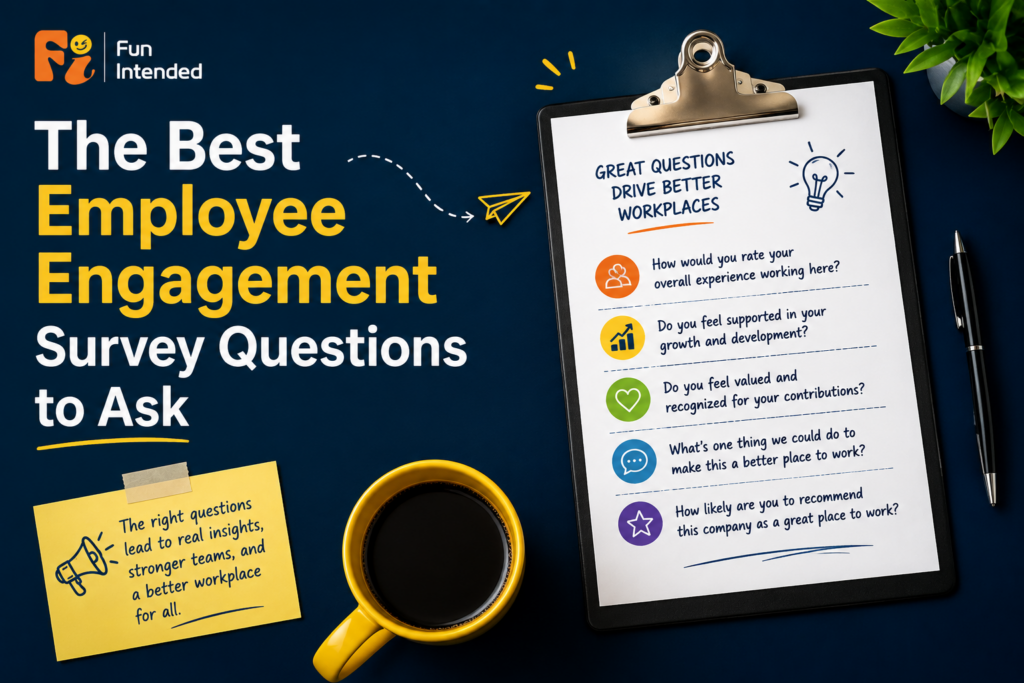
Most companies know they should be surveying their employees. Fewer companies know how to ask the right questions.
The difference matters more than it sounds. A poorly designed survey gives you data that feels comprehensive but points nowhere. Vague questions produce vague answers. Leading questions produce polite answers. And a survey that asks about everything without structure leaves HR teams staring at a spreadsheet full of numbers they do not know how to use.
Employee engagement dropped to just 21% globally in 2024, costing the global economy $8.9 trillion in lost productivity. For organizations trying to move that number, the survey is often the first tool they reach for. Getting the questions right is where the whole thing either works or falls flat.
Here is a category-by-category breakdown of the best employee engagement survey questions, what each one is really measuring, and how to use the answers once they come back.
Before the Questions: What Makes a Survey Worth Taking
One thing worth establishing before diving into the questions themselves: the best survey in the world fails if employees do not trust the process behind it.
The average survey response rate across industries sits around 30 to 40%, but well-run employee engagement surveys consistently perform far above that. For organizations with fewer than 500 employees, a response rate of 80 to 90% is considered the ideal benchmark. The gap between average and ideal is almost entirely explained by trust: whether employees believe the survey is anonymous, whether leadership has acted on past feedback, and whether participation actually feels worth their time.
Before you send a single question, make sure employees understand what the survey is for, how their responses will be used, and what they can realistically expect to see happen after. Anonymity should be guaranteed and clearly communicated. That foundation is what turns a survey from a checkbox exercise into a tool that generates honest, usable signal.
With that in place, here is what to ask.
Category 1: Overall Engagement and Loyalty
These questions establish your baseline. They measure the emotional connection employees have with the organization and give you a headline number to track over time.
“On a scale of 0 to 10, how likely are you to recommend this company as a place to work?”
This is the employee Net Promoter Score (eNPS), and it is one of the most widely used engagement benchmarks in the industry. Responses break into three groups: Promoters (9 to 10), who are actively enthusiastic about the organization; Passives (7 to 8), who are satisfied but not deeply loyal; and Detractors (0 to 6), who may be disengaged or actively looking elsewhere. Companies like Salesforce implement quarterly eNPS measurements to track engagement trends over time, using it as an early warning system for culture shifts.
“I feel proud to work for this organization.”
Sometimes called the “barbecue test,” this question measures whether employees are brand ambassadors or whether they quietly change the subject when someone asks where they work. Low scores on this question often reflect a gap between what the organization says it stands for and what employees actually experience on a daily basis.
“I plan to still be working here in two years.”
This is a direct retention signal. It measures future intent, not just current satisfaction, which makes it one of the most actionable questions on the survey. When scores here decline, it is worth investigating whether career pathing, recognition, or leadership trust is the driver before the departures start.
Category 2: Leadership and Communication
Only 20% of U.S. employees trust their organization’s leadership, according to Gallup’s 2024 data. That number should be alarming to anyone responsible for culture and retention, because trust in leadership is one of the strongest predictors of whether employees stay or go.
“Senior leadership communicates a clear direction for the future.”
This question surfaces whether employees understand where the company is headed and why it matters. When this score is low, engagement tends to follow, because it is hard to commit yourself to an organization whose direction feels opaque or uncertain.
“I feel informed about decisions that affect my work.”
Transparency is not the same as over-communication. This question measures whether the right information is reaching employees at the right time. Low scores here often point to a structural communication breakdown, not a leadership character problem, which means it is fixable with the right infrastructure.
“My manager supports my growth and development.”
The relationship between an employee and their direct manager is one of the most significant drivers of engagement at any level. Manager engagement itself declined from 30% to 27% between 2023 and 2024, a trend that ripples downward through every team those managers lead. This question tells you whether your frontline leaders are functioning as coaches or simply as task supervisors.
Category 3: Recognition and Value
Recognition is one of the most consistently cited factors in both engagement and retention. It is also one of the areas where the gap between what companies think they are doing and what employees actually feel tends to be the widest.
“I receive meaningful recognition when I do good work.”
The word “meaningful” is doing a lot of work in this question. It filters out token praise and measures whether recognition lands as genuine appreciation or just noise. Low scores here are a signal that your recognition program needs more specificity, more frequency, or a broader platform to operate on.
“My contributions are valued by this organization.”
This question measures something slightly different from recognition. It asks whether employees feel that what they bring matters, not just whether they have recently been praised for it. An employee can receive a “great job” email and still feel like their ideas, concerns, and expertise are ignored. This question surfaces that gap.
“People at this organization are recognized for going above and beyond.”
This is a cultural question as much as an individual one. It asks whether employees see others being recognized around them, which shapes their own expectations and behaviors. Companies with engaged teams see 23% higher profitability and 43% lower turnover than those with disengaged workforces, and peer-visible recognition is one of the most reliable levers for building that kind of culture.
A well-designed rewards and recognition platform addresses both the individual and the cultural dimension of these questions, making appreciation visible, frequent, and connected to the behaviors the organization actually wants to reinforce.
Category 4: Growth and Development
Career stagnation is one of the leading drivers of voluntary turnover. 50% of employees believe their company needs to offer more growth opportunities, and when employees cannot picture their next step, they start looking for it somewhere else.
“I have opportunities to learn and grow in my current role.”
This question measures whether employees feel challenged and supported in their day-to-day work, not just whether a formal development program exists on paper. An employee who answers “disagree” to this question is telling you they are ready to plateau or leave.
“I can see a clear path for my career development at this organization.”
Visibility is everything here. An employee might have a dozen potential paths forward, but if no one has mapped them out or communicated them clearly, they effectively do not exist. This is why structured career pathing frameworks matter as a practical retention tool and not just an HR project.
“This organization is committed to my professional development.”
This question measures institutional investment, not just individual opportunity. It asks whether employees believe the organization sees their growth as a priority. Scores on this question tend to correlate strongly with how recently an employee has had a meaningful development conversation with their manager and whether that conversation led to anything tangible.
Fun Intended’s LMS training platform and mentorship program are both designed to address the gaps these questions surface, giving employees structured pathways and paired support to develop within the organization rather than seeking that growth elsewhere.
Category 5: Team Connection and Culture
Engagement does not happen in isolation. The quality of relationships employees have with their colleagues is a significant driver of belonging, motivation, and day-to-day satisfaction.
“I feel a strong sense of belonging at this organization.”
Belonging has moved from a soft concept to a measurable engagement driver. Employees who feel like they belong show up differently than those who feel like they are tolerated. This question is particularly important in hybrid or remote environments where informal connection happens less naturally.
“My team works well together to get things done.”
Low scores here can indicate interpersonal conflict, unclear ownership, or structural barriers to collaboration. They can also reflect a management problem, since teams tend to mirror the communication style and expectations of their direct leader.
“I feel comfortable sharing my ideas and concerns at work.”
Psychological safety is the foundation of any high-performing team. When employees do not feel safe speaking up, problems compound in silence. This question is the early warning signal for cultures where people have learned that raising concerns is more risk than it is worth.
Category 6: Workload and Well-Being
Burnout has become one of the most significant engagement challenges of the current era. Questions about workload and well-being help organizations catch unsustainable patterns before they become a retention crisis.
“I am able to maintain a healthy balance between my work and personal life.”
This question measures whether the organization’s demands are sustainable. Employees who feel supported are less likely to experience burnout and more likely to be productive and engaged over the long term. Declining scores here are often an early signal of rising absenteeism and disengagement that shows up in behavioral data weeks or months later.
“My workload is manageable.”
Specificity matters here. This question is distinct from the work-life balance question because it focuses on volume and prioritization rather than boundaries. An employee can have good work-life balance overall and still feel overwhelmed by unclear priorities or under-resourced projects.
The Open-Ended Question You Should Always Include
Every engagement survey should close with at least one open-ended question that gives employees room to say what the structured questions did not ask.
“Is there anything else you would like to share about your experience working here?”
This question catches the things your survey categories missed. It is where you learn about a specific manager who is struggling, a process that has been broken for months, or a culture issue that is difficult to reduce to a rating scale. 46% of employees wish their organization did more to act on survey feedback, and open-ended responses are often where the most actionable insights live.
What to Do With the Answers
Collecting the data is the easy part. What happens next is where most organizations either build trust or erode it.
Share results with employees, even when they are uncomfortable. Acknowledge what you heard. Be specific about what you are going to change and by when. And follow through. When leaders collect feedback but do not act, employees notice and participation drops in the next survey cycle. The survey itself becomes evidence of whether the organization actually listens.
This is exactly what the engagement transformation at TAS United demonstrated. Structured feedback channels, visible responses from leadership, and clear action taken on what employees shared were foundational to the trust that made everything else possible. You can read the full story in the TAS United employee engagement case study.
The best employee engagement survey questions are only valuable when they feed into a system built to respond. If your organization is ready to build that system, Fun Intended’s employee engagement consulting can help you design a listening strategy that collects the right signal and turns it into something your employees can actually see.
Want help designing an employee engagement survey that gives you data you can act on? Get in touch with Fun Intendedto start the conversation.