
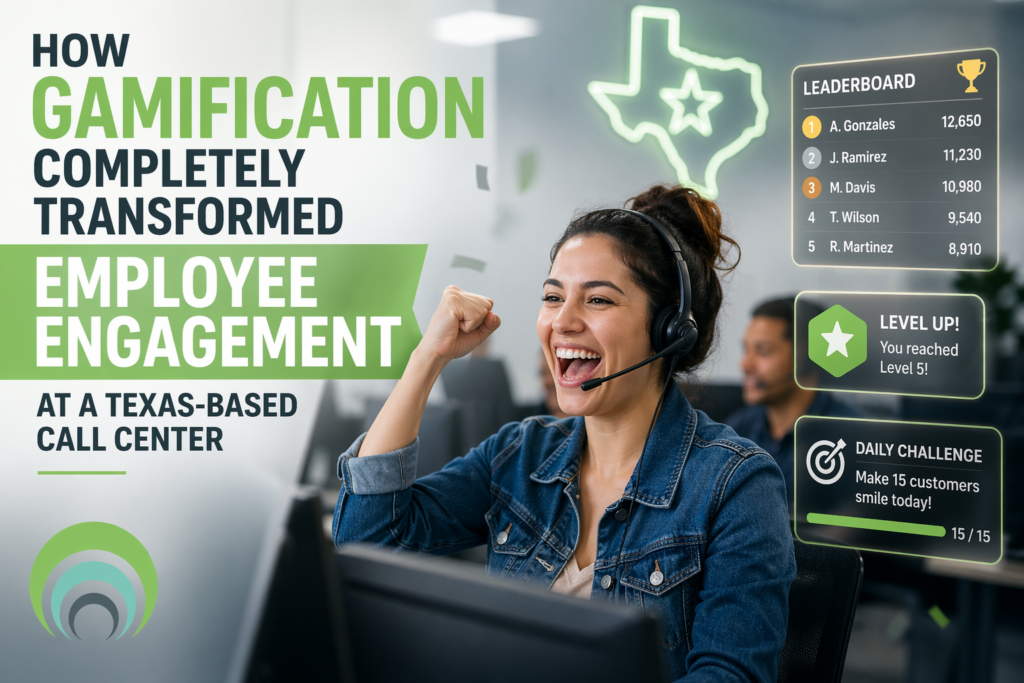
Call centers are notoriously tough places to work. High stress, repetitive tasks, and limited career visibility make them breeding grounds for burnout and turnover. So when a Texas-based call center managed to slash its employee turnover rate by 82% in just 12 months, it turned heads. The secret? A comprehensive employee engagement strategy with gamification at its core. That’s how gamification transformed employee engagement.
This is the story of TAS United, a US-based call center operation employing roughly 200 people, and how partnering with Fun Intended turned a culture in crisis into one worth staying for.
The Employee Engagement Crisis Hiding in Plain Sight
Before the transformation, TAS United was cycling through one and a half times its entire workforce every single year. That is not just an HR headache. It’s an operational crisis.
The call center industry as a whole has long struggled with retention. Industry data shows that call center turnover rates average 40 to 45% annually, with high-stress sectors reaching even higher. Replacing a single agent can cost anywhere from $10,000 to $20,000 in direct expenses, and the total impact including lost productivity can reach $46,000 per agent. For a 200-person operation, those numbers compound fast.
At TAS United, employee surveys and exit interviews pointed to four root causes driving people out the door:
- Low morale from a persistently challenging work environment
- Distrust of leadership rooted in poor communication and a lack of transparency
- Operational instability from unpredictable scheduling that disrupted work-life balance
- No visible path forward: Employees saw dead-end jobs with no growth opportunities
These are problems that no ping-pong table or pizza party can fix. They require a real strategy.
Why “Gamification Transformed Employee Engagement” Are More Than Buzzwords
Before diving into what TAS United did, it’s worth understanding why gamification works in the first place.
Research shows that gamified workplace programs can increase employee engagement by up to 60% and boost productivity by 50%. A separate study found that 90% of employees say gamification makes them more productive, and 52% of HR departments report better employee retention after integrating gamification into their workforce programs. These are not small numbers.
The reason goes deeper than fun. When people have clear goals, visible progress, real-time feedback, and recognition for their efforts, they stay engaged. Games are designed around exactly those principles. When those mechanics are applied to real work, the result is a workforce that is motivated not just to show up, but to perform.
According to Gallup’s State of the Global Workplace Report 2024, only 23% of employees worldwide are engaged in both their work and their workplace. That means the vast majority of workers are mentally somewhere else. Gamification gives organizations a proven lever to close that gap.
How Gamification Transformed Employee Engagement at TAS United
Between July 2022 and July 2023, Fun Intended implemented a multi-phase strategy at TAS United. While gamification was a key pillar, it was deliberately woven into a broader ecosystem of changes designed to address every root cause identified in the research phase.
Here is how the pieces came together.
Interactive Games and Contests Tied to Real KPIs
The gamification component went well beyond leaderboards for the sake of leaderboards. Fun Intended designed interactive games and contests directly tied to key performance indicators that mattered to the business. Think call resolution rates, customer satisfaction scores, and adherence to schedules.
By connecting gameplay to meaningful metrics, employees could see exactly how their daily performance contributed to something larger. And because the competitions were built to be healthy rather than cutthroat, they created energy on the floor rather than anxiety. Visually appealing design made the challenges feel professional and engaging rather than like an afterthought bolted onto a spreadsheet.
The results spoke for themselves: games and contests consistently drove KPI improvements throughout the program.
A Rewards and Recognition Platform That Actually Recognized People
Alongside the gamified contests, TAS United deployed an online rewards and recognition platform that made appreciation visible and frequent. The platform enabled peer-to-peer recognition, not just top-down praise, which is significant because employees who feel valued by their peers report much stronger connection to the team.
Recognition matters in measurable ways. It’s one of the most cited reasons employees stay or leave, and it costs far less to implement than another round of recruiting.
Training That Employees Actually Wanted to Complete
A new Learning Management System was implemented to standardize training and make it more engaging. Clear learning pathways were created for both new hires and existing team members, and time-to-proficiency for new agents improved as a result. Training completion rates also climbed significantly across the organization.
Research from SHRM shows that gamified training can lead to a 60% increase in engagement and improve skills retention by 40%. When employees feel prepared and supported in their roles, they are far less likely to walk out the door.
Career Pathing That Gave People a Reason to Stay
One of the most powerful retention tools was the simplest: showing people where they could go. A career development framework was established that mapped out clear advancement routes from entry-level to senior positions. Annual performance reviews were introduced to discuss growth, and leadership training was provided for supervisors and managers.
Employees who can see a future at a company invest in that future. Employees who cannot, leave.
Communication Infrastructure That Rebuilt Trust
At the foundation of everything was a complete overhaul of how the organization communicated. A monthly internal newsletter was launched to share company news and celebrate achievements transparently. Clear and consistent communication channels were established between leadership and frontline employees. A digital suggestion box gave employees a voice, and management actually acted on what it heard.
Fun Intended’s consulting approach emphasizes that most trust issues in organizations stem from communication breakdowns. Fixing those breakdowns did not happen overnight, but the infrastructure put in place gave every subsequent initiative a stronger foundation to stand on.
The Results: What an 82% Reduction in Turnover Actually Looks Like
After 12 months, the numbers were dramatic.
TAS United achieved an 82-percentage-point reduction in turnover, representing a 53% relative improvement. This translated to approximately $650,000 in annual savings on recruitment, onboarding, and training costs alone.
Beyond the financial impact, every program launched hit its objectives:
- The monthly newsletter maintained high open and engagement rates
- The rewards platform saw active participation across all departments
- Employee suggestions led to tangible operational improvements
- Games and contests drove consistent KPI performance month over month
- Career pathing reduced the “dead-end job” perception that had been fueling exits
As TAS United President Kevin Ryan put it: “You did a huge thing! In an industry where turnover is problematic, you’ve created a program that has changed our company forever!”
Gamification Works Best as Part of a Bigger Strategy
One of the most important takeaways from this case study is that gamification did not work in isolation. According to AmplifAI’s gamification research, organizations that combine gamification with structured coaching and performance feedback see the strongest returns. TAS United’s results back that up.
The games and contests drove motivation. The recognition platform reinforced that motivation with visibility. The LMS gave employees skills to put their motivation to use. The career framework gave them a reason to channel that motivation into a long-term commitment. And the communication infrastructure made sure none of it felt like a gimmick.
That layered approach is what the Fun Intended platform is designed around. Engagement is not a single feature. It is a system.
What Other Businesses Can Learn From This
The call center industry is not getting easier. Remote and hybrid work has permanently changed what employees expect from their employers. Burnout is rampant. Tenure is shrinking. And the cost of ignoring these trends keeps climbing.
But TAS United’s results show that improvement is absolutely achievable, even in one of the toughest retention environments in the workforce. A few principles stand out from their journey:
- Address root causes, not symptoms. Surveys and exit interviews revealed the real problems. The strategy targeted those directly.
- Make recognition visible. Peer-to-peer appreciation and public acknowledgment of wins changed how employees felt about coming to work.
- Give people a path forward. Career visibility is a retention tool, and it is free to build.
- Communicate like it matters. Transparency from leadership is not a nice-to-have. It is the foundation of trust.
- Use data to drive the fun. Tying gamification to real KPIs turned friendly competition into business results.
Gamification transformed employee engagement at TAS United. But it didn’t happen because someone installed a leaderboard. It happened because a team took employee engagement seriously, designed a system that addressed every layer of the problem, and committed to it.
That is what gamification for employee engagement looks like when it is done right.
Interested in bringing this kind of transformation to your organization? Learn more about Fun Intended’s gamification and engagement services or get in touch to start the conversation.