
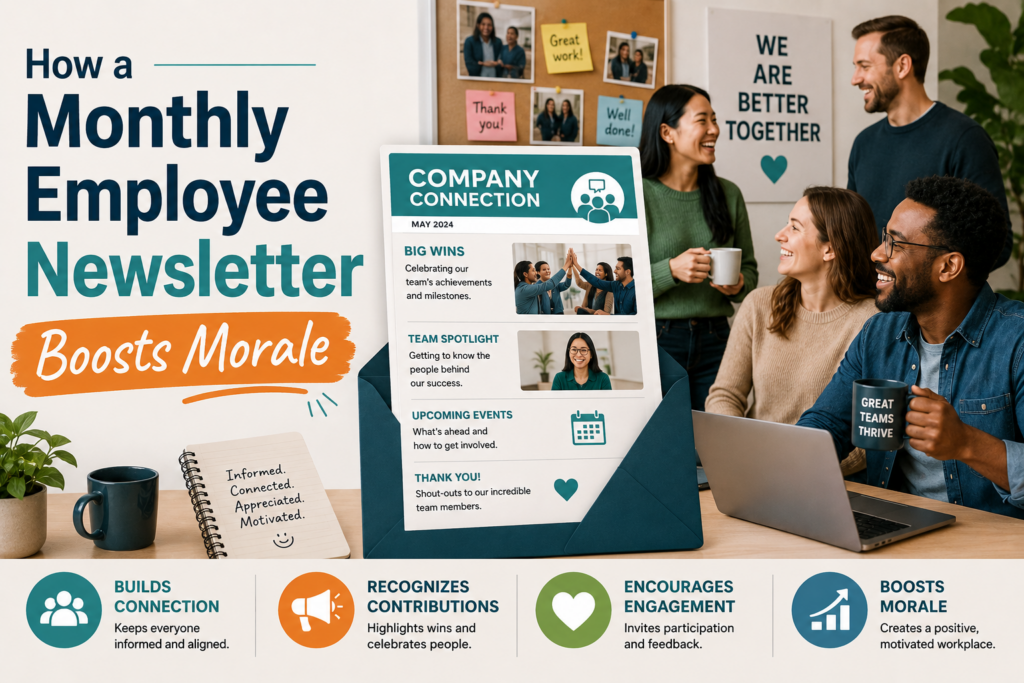
A monthly employee newsletter is one of the simplest, most cost-effective tools available for closing that gap. Here’s why it works, what to put in it, and what a good one actually looks like in practice.
Most organizations have a communication problem they don’t fully recognize yet.
It’s not that leadership’s hiding things from employees. It’s that the day-to-day noise of running a business means important information does not always reach the people who need it. Employees find out about company wins through the grapevine. They learn about changes after the fact. They go weeks without hearing anything from leadership and gradually start to feel like spectators at their own workplace rather than participants in it.
Over time, that feeling erodes morale. And morale, once eroded, is expensive to rebuild.
Poor internal communication costs U.S. businesses an estimated $1.2 trillion annually. That is not a rounding error. It is the accumulated cost of employees who are confused, disengaged, and disconnected from the organization they show up to every day.
The Connection Between Information and Morale
Before getting into the mechanics of a newsletter, it is worth understanding why being informed matters so much to how employees feel about their jobs.
When employees do not know what is happening in their organization, they fill that vacuum themselves. Rumors form. Assumptions get made. Small uncertainties grow into large anxieties. And in that environment, trust in leadership deteriorates quietly, long before it shows up in any engagement survey.
The research on this is striking. 85% of employees say they are most motivated when management provides regular company updates, because being aware of what is happening gives them a sense of purpose and connection to their role. It is not that employees need to know every detail of every decision. It is that regular communication from leadership signals that employees are part of the story, not just bystanders to it.
Research from Nectar HR found that 91% of employees say internal communication has the most significant impact on their morale, with a BMC Psychology study identifying three core psychological drivers: a healthy work environment built on psychological safety and open dialogue, a sense of clarity and purpose in their role, and emotional fulfillment through gratitude and belonging. A well-run newsletter touches all three of those drivers every single month.
Employees who believe their company communicates transparently have 8.8 times greater job satisfaction than those who feel they are kept in the dark. That number should make a compelling case for anyone still treating internal communication as a secondary HR task.
Why a Monthly Employee Newsletter Works Better Than Ad Hoc Communication
Most organizations communicate reactively. Something happens, an email goes out. A question comes up, a manager addresses it in a team huddle. A new policy gets introduced, HR sends a memo. Each of these things is better than silence, but none of them build the sustained sense of connection that consistent communication creates.
A monthly employee newsletter changes the dynamic because it is expected. It arrives on a regular schedule. Employees know it is coming, which means they are already primed to receive it. Over time, it becomes a ritual rather than a notification, and rituals are what culture is made of.
Internal newsletters are among the top tools organizations use for internal communication, alongside email and platforms like Microsoft Teams. They work because they combine the reach of email with the curated, intentional voice of editorial content. A newsletter is not just an announcement. It is a demonstration of what the organization cares about, week by week and month by month.
72% of organizations that increased their investment in communications saw improved culture or morale, compared to 28% with flat or reduced communication investment. 68% saw improved employee retention as a direct result. The newsletter is not the entire communication strategy. But for many organizations, it is the most consistent, visible part of it.
What to Put In a Monthly Employee Newsletter
The content of a monthly employee newsletter determines whether employees actually read it. A newsletter full of corporate announcements and policy updates will get skimmed and closed. A newsletter that celebrates real people, acknowledges real challenges, and shares information that is genuinely useful will get read, shared, and talked about.
Here is a framework for what to include each month:
Company Updates and Direction
Leadership has a responsibility to share where the organization is headed and how it is performing. Employees who understand company goals are dramatically more productive and motivated than those who do not. When employees clearly understand company goals and are engaged with them, productivity increases by 63% and motivation improves by 59%.
This does not mean sharing sensitive financial details or projecting false optimism. It means giving employees a regular, honest picture of the big things: what is going well, what challenges the company is working through, and where the organization is heading. Employees who feel like they understand the direction are far more likely to feel invested in contributing to it.
Employee Recognition and Wins
A newsletter is one of the most powerful visibility tools an organization has. When an employee’s contribution gets named and celebrated in a publication that the whole company reads, it sends a message to everyone, not just that person, that going above and beyond gets noticed.
By sharing employee achievements, recognition, and stories, a newsletter boosts morale and increases motivation across the entire team. It also reinforces the behaviors the organization wants to see more of. When people watch their colleagues get recognized publicly for demonstrating company values or delivering exceptional work, they understand what those values look like in practice rather than just on a poster on the wall.
This is why the newsletter works so well in combination with a structured rewards and recognition platform. The platform drives the day-to-day peer recognition. The newsletter amplifies the best of that recognition to the entire organization, making the culture of appreciation visible and consistent.
Department Spotlights
One of the most common sources of disconnection in organizations is that employees have very little visibility into what other teams are actually doing. The customer service team does not know what the operations team is working on. The sales team does not understand the challenges the support team is navigating. Over time, this creates silos and a fragmented sense of organizational identity.
A monthly spotlight on a different team or department builds bridges across those silos. It gives employees context about the broader organization, fosters cross-functional respect, and creates a genuine sense of shared purpose. Featuring stories and contributions from different departments helps bridge communication gaps and fosters collaboration across the organization.
Career Development and Learning Opportunities
The newsletter is a natural channel for surfacing the growth resources employees have available to them. When upcoming training sessions, new learning pathways, or mentorship opportunities are highlighted in a communication that the entire company reads, take-up rates improve significantly. Information that lives in a shared drive nobody visits gets acted on when it lands in a monthly publication people actually read.
This connection between communication and development is one of the reasons the newsletter is such a natural partner to Fun Intended’s LMS training platform. The newsletter keeps development visible and top of mind. This increases the likelihood that employees take the next step on their career path rather than assuming no path exists.
A Word From Leadership
Not every issue needs a feature-length message from the CEO. But a brief, genuine note from a leader, addressing something real and relevant, does something that no policy memo or town hall can fully replicate. It humanizes leadership. It creates a regular moment of connection between the people at the top of the organization and the people doing the work. And it signals that leadership is paying attention.
The key word here is genuine. Employees can tell the difference between a corporate-sounding message that was written to check a box and an honest note from someone who actually cares about the organization and the people in it. The former gets scrolled past. The latter gets remembered.
What Happens When You Don’t Communicate Consistently
The absence of regular communication has consequences that are easy to underestimate because they accumulate slowly.
Employees thought that internal communication had the most significant impact on company culture at 93%, employee morale at 91%, and employee engagement at 89.7%. Those are not marginal effects. Communication is the infrastructure that all of the other engagement tools sit on. Recognition programs work better when employees are informed about them. Career pathing resonates more when employees understand where the organization is going. Pulse surveys produce more honest responses when employees trust that leadership is being transparent with them.
When communication is inconsistent or absent, the whole system loses integrity. Employees stop trusting the recognition as genuine. They stop believing in the career paths as real. They stop engaging with the surveys as meaningful. Everything else an organization does to build engagement becomes harder.
This was one of the most important lessons from Fun Intended’s work with TAS United, the Texas-based call center that reduced turnover by 82 percentage points in 12 months. A monthly newsletter was not a peripheral element of that transformation. It was foundational. It rebuilt the trust between leadership and employees that years of poor communication had eroded, and it created the conditions in which every other engagement initiative could actually land. You can read the full case study here.
What a Good Monthly Employee Newsletter Actually Looks Like
A few practical principles for building a newsletter employees look forward to rather than ignore:
Keep it readable. No one is going to read a wall of text. Use clear sections, short paragraphs, and a consistent structure that employees can navigate quickly. The goal is for someone to be able to get through the whole thing in five minutes.
Be consistent with the schedule. A newsletter that arrives on the first Monday of every month becomes expected. One that arrives whenever someone remembers to send it becomes easily ignorable. Consistency is what turns a one-off communication into a cultural rhythm.
Write like a human. The most read newsletters have a voice. They feel like they were written by a person who cares about the audience, not drafted by committee and approved by legal. Warmth, humor, and directness are all welcome.
Make recognition specific. When you call out an employee in the newsletter, name the specific thing they did and why it mattered. Generic praise does not move people. Specific, detailed acknowledgment does.
Close the loop on feedback. If employees raised concerns in a previous pulse survey or suggestion box, the newsletter is a natural place to acknowledge what was heard and what is being done. This is the single most powerful thing a newsletter can do for trust: show that feedback leads to visible action.
The Monthly Employee Newsletter as Part of a Broader Engagement System
A newsletter works best when it’s not standing alone. It amplifies recognition that is happening daily on the Fun Rewards platform, amplifies development opportunities that employees can pursue through The Fun Train LMS, and amplifies the mentorship relationships being built through FunFluence. And it creates the transparency and trust that make employees more willing to engage honestly when the next pulse survey lands in their inbox.
Think of the newsletter as the organization’s voice. When that voice shows up consistently, with genuine content and visible follow-through, employees start to believe that leadership is paying attention and that their experience at work matters. That belief is the foundation everything else is built on.
Where to Start
If your organization does not have a consistent internal newsletter yet, the bar to entry is low. You do not need a design team or a content department. You need a clear purpose, a consistent schedule, and someone willing to write honestly about what is actually happening in the organization.
Start with one issue. Include a company update, one or two employee recognitions, and a note from a leader that sounds like a real person wrote it. Send it, track who opens and reads it, and use that data to improve the next one.
If you want help building communication infrastructure that connects to a broader engagement strategy, Fun Intended’s employee engagement consulting is built for exactly that kind of work. The newsletter is a starting point. The goal is a culture where employees feel informed, valued, and genuinely connected. Not just to the work they are doing, but to the organization they’re doing it for.
Ready to build a communication strategy that keeps your team informed and your culture moving in the right direction? Get in touch with Fun Intended and let’s talk through what that could look like for your organization.