
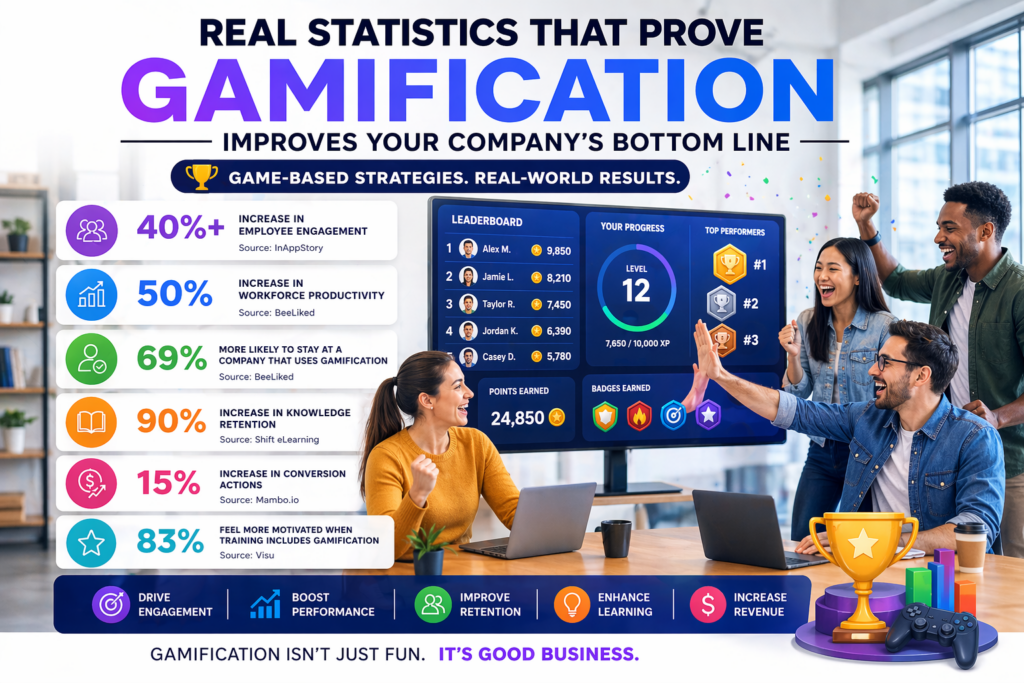
Gamification has quietly become one of the most effective ways to improve employee performance and engagement. What used to feel like a novelty is now backed by real data that shows measurable impact across entire organizations. Bottom line: Gamification improves company revenue.
For example, a study highlighted by AmplifAI found that companies implementing gamification have seen engagement increases ranging from 100% to 150%. That isn’t a small lift. That’s a complete shift in how employees interact with their work.
Engagement Improves Fast When Gamification Is Done Right
When employees are engaged, everything else tends to follow. Productivity improves. Retention improves. Even customer experience improves.
Research shows that gamification improves company revenue by increasing employee engagement by more than 40%, according to InAppStory. In some cases, companies have seen engagement increases closer to 60%, as noted by Körber.
If you think about it, this makes sense. People respond to progress, recognition, and a clear sense of achievement. Gamification brings all of that into the day-to-day workflow.
If you are looking at engagement from a bigger picture perspective, this ties directly into how platforms like Fun Intended’s employee engagement platform are designed to connect recognition, training, and performance into one experience.
Productivity Gains Are Hard to Ignore
This is where the ROI of gamification really starts to show up.
Companies have reported productivity increases of up to 50%, based on insights from BeeLiked. Even more interesting, around 90% of employees say gamification makes them more productive, according to Forbes.
That kind of consistency across different studies tells a clear story. When employees can see progress, compete in a healthy way, and earn recognition, they tend to perform better.
This is exactly why tools like Fun Intended’s gamification system are built to tie daily actions directly to measurable outcomes.
Retention Improves When Work Feels Rewarding
Retention is one of the most expensive problems companies deal with. Hiring is expensive. Training is expensive. Losing good people is even more expensive.
Gamification helps solve that.
According to BeeLiked, 69% of employees say they would stay longer at a company that uses gamification. On top of that, organizations have reported turnover improvements of up to 45%, based on research from Shift eLearning.
Those numbers are hard to ignore.
When employees feel recognized and see progress in their work, they are far less likely to start looking elsewhere. That’s why engagement strategies like Fun Intended’s approach to employee engagement focus heavily on creating consistent, rewarding experiences.
Learning Sticks Better With Gamification
Training is another area where gamification delivers immediate value.
Gamified learning can increase knowledge retention by up to 90%, according to Shift eLearning. That’s a massive difference compared to traditional training methods.
Additional research published on ScienceDirect shows that employees in gamified training environments not only learn faster, but also apply what they learn more effectively.
This is why learning systems like The Fun Train LMS are moving toward more interactive, gamified experiences instead of static content.
Revenue and Business Growth Follow Engagement
At the end of the day, every business wants to know the same thing. Does this impact the bottom line?
The answer is yes.
Gamification has been shown to increase conversion-related behaviors by around 15%, according to Mambo.io. Some organizations have even reported profitability increases as high as 7x, based on findings from BeeLiked.
When employees are more engaged, more productive, and better trained, revenue growth tends to follow.
This is why measuring engagement through platforms like Fun Intended’s ROI-focused approach is becoming more important for leadership teams.
Motivation Is the Hidden Driver
One of the most overlooked parts of gamification is motivation.
According to Visu, 83% of employees say they feel more motivated when training includes gamification. That lines up with additional research showing improvements in job satisfaction and morale when gamification is part of the experience, as highlighted by ACR Journal.
Motivation is not always easy to measure, but it shows up in performance, consistency, and overall attitude.
Why These Statistics Matter
When you look at all of this together, the pattern becomes clear.
Gamification improves:
- Engagement
- Productivity
- Retention
- Learning
- Revenue
That is the full picture of the ROI of gamification.
It works because it taps into how people naturally think and behave. People like progress and recognition. People like to feel like their work matters.
Final Thoughts
Gamification improves company revenue. This is not theoretical. It’s measurable, repeatable, and already being realized by organizations across multiple industries.
Companies that invest in gamification are not just making work more enjoyable. They are building systems that drive performance and long-term growth.
And the companies that figure this out early are the ones that will continue to pull ahead.