
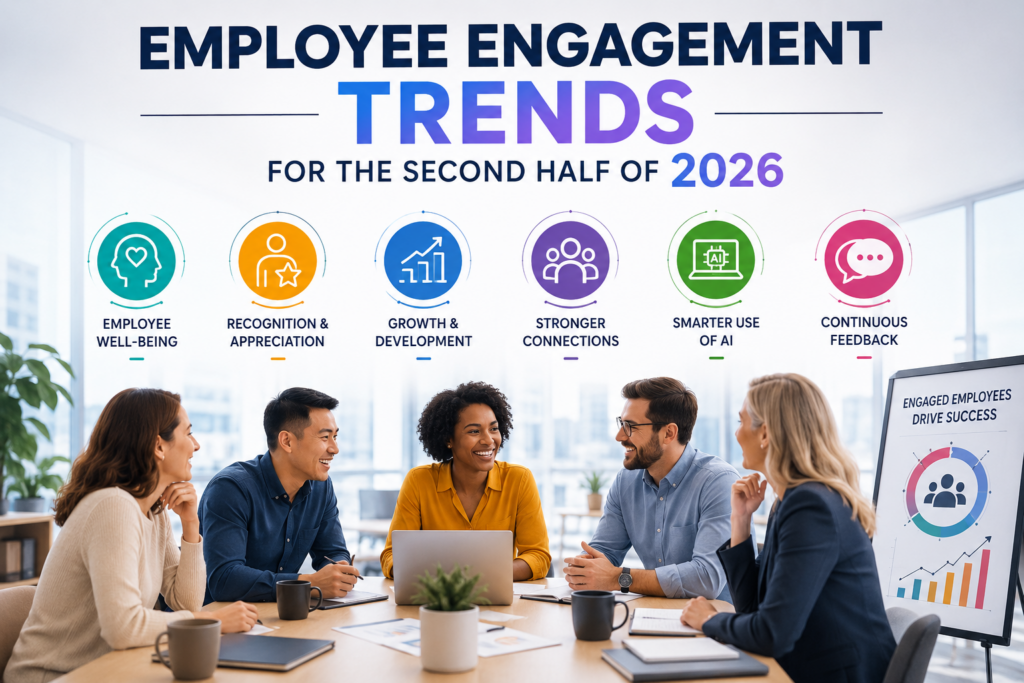
Global employee engagement fell to 20% in 2025. These employee engagement trends mark the second consecutive year of decline and the lowest level since 2020, per Gallup’s State of the Global Workplace 2026 report. No region of the world improved. The decline cost the global economy an estimated $10 trillion in lost productivity.
The second half of 2026 is arriving with a workforce that is stretched, skeptical, and watching. Employees are not simply disengaged. They are evaluating whether the organizations they work for deserve their commitment. The ones that earn it will win the talent, the productivity, and the culture that follows.
The ten trends below define where that battle is being fought. Each represents a pressure point and a specific opportunity for leaders willing to act. Each also connects to deeper Fun Intended content for anyone who wants to go further.
1. AI and Employee Engagement Trends
AI anxiety is amplifying disengagement across every industry. Workers are not simply uncomfortable with new tools. They are questioning whether their roles will survive, and only one in three says their employer is helping them navigate the shift.
The companies holding engagement together through AI disruption are the ones making employees feel like partners in the change rather than casualties of it. Transparency about what AI will and will not replace is the foundation. Pairing that with active reskilling investment is the engagement strategy that works right now.
Go deeper: How to Keep Employees Engaged When AI Is Changing Their Jobs
2. Manager Engagement
This is the most urgent trend in the entire report. According to ContactMonkey’s reporting on Gallup’s 2026 data, manager engagement fell from 30% to 27% globally. Among managers under 35, it dropped five percentage points. Among women managers, it dropped seven.
That matters because 70% of team engagement is directly attributable to the manager. When managers are disengaged, their teams are too. The cascade effect runs downward through every metric organizations track.
Managers in 2026 are caught between new executive priorities and employee expectations that are harder to meet than ever. They are being asked to do more with less clarity and less support. Fixing manager engagement is the highest-leverage engagement investment available to any HR leader right now.
Go deeper: Why Manager Quality Is the Biggest Driver of Team Engagement
3. Employee Recognition
Only 39% of employees feel someone at work cares about them as a person. That is down from 47% in 2020, per Gallup. Recognition is the most direct tool available for closing that gap, and it remains one of the most underdeployed.
Frequency matters more than value. Employees recognized daily are nearly three times more engaged than those recognized weekly or less. Yet most programs still anchor to annual events. The companies closing the recognition gap make high-frequency, real-time acknowledgment part of the daily workflow.
Go deeper: Why Recognition Frequency Matters More Than Recognition Value
4. Employee Engagement Trends on Burnout
Burnout in 2026 has gone underground. Inspirus’s Q3-Q4 2026 HR Trends report names it one of six converging pressures facing HR this year. Manager disengagement and AI-related challenges are on the same list.
The shift is significant. Employees are no longer loudly burning out. They are quietly absorbing unsustainable workloads while presenting a surface appearance of stability. That pattern is far harder to detect and far more damaging to act on late.
Only 46% of U.S. employees clearly know what is expected of them at work. That clarity gap, down from 56% in 2020, is a direct driver of burnout. Employees operating without clear expectations expend more emotional energy guessing than doing. Recognition programs and regular feedback both reduce that drain.
Go deeper: The Hidden Cost of Burnout and How Engagement Tools Prevent It
5. Career Development
Employees cite development opportunities as the most important factor in whether they feel engaged. That has not changed. What has changed is the timeline.
Gen Z expects a promotion within 18 months. Early-career workers feel AI’s impact most acutely and are first to leave when development is absent. Traditional entry-level positions are disappearing as AI reshapes routine tasks. Organizations need to offer meaningful growth paths before employees decide there are none.
LMS platforms, mentorship programs, and clearly visible career paths are not HR nice-to-haves in the second half of 2026. They are retention infrastructure.
Go deeper: LMS Platform Upskilling: Building Your Internal Promotion Pipeline
6. Personalized Employee Experiences
The era of one-size-fits-all engagement programs has ended. Employees in 2026 expect experiences tailored to their role, life stage, tenure, and goals. That expectation is being shaped by every consumer experience they have outside of work.
Personalization in 2026 means segmenting recognition, learning, and communication by audience rather than broadcasting uniformly. A recent graduate with student debt experiences work differently than a mid-career employee caring for aging parents. Programs that acknowledge that difference outperform those that ignore it.
Employees who feel belonging and connection to their team show 56% higher engagement, according to BetterUp’s belonging research. Personalization is how belonging gets built at scale.
Go deeper: What Gen Z Actually Wants From an Employer and How to Deliver It
7. Gamification
Gamification is no longer a novelty feature. It is a primary engagement mechanism for companies competing for the attention of a workforce that grew up with interactive digital experiences.
Companies using gamification report a 48% increase in employee engagement. Gamified training programs reach a 90% completion rate compared to 25% without. Organizations using gamification are seven times more profitable than those that do not.
In the second half of 2026, gamification is showing up not just in training but in onboarding, recognition, safety, wellness, and innovation programs. The mechanics are the same. The application keeps expanding.
Go deeper: The Science Behind Gamification and Why It Drives Productivity and Focus
8. Mentorship
Mentorship is one of the most effective and most underbuilt engagement tools available. Mentored employees have a 72% retention rate compared to 49% for those without a mentor. Four in ten workers without a mentor have considered quitting in the past three months.
The reverse mentorship trend is adding another dimension in 2026. Junior employees are mentoring upward, sharing digital fluency and Gen Z insight with senior leaders who need both. Programs built in both directions produce knowledge transfer, engagement outcomes, and cross-generational relationships that hold workforces together.
Go deeper: Why Mentorship Closes the Skills Gap Faster Than Any Training Program
9. Continuous Feedback
The annual performance review is functionally obsolete as a primary engagement tool. Employees in 2026 need feedback on a timeline that matches the speed at which their work changes.
Quarterly stay interviews have proven far more effective than exit interviews conducted after the fact. Organizations with strong internal communication see 47% higher engagement, per Forbes research. Continuous feedback creates employees who feel informed and valued rather than processed once a year.
Pulse surveys, manager check-ins, and peer recognition platforms all contribute to a feedback culture that catches disengagement early and acts on it before it becomes a departure.
Go deeper: Stay Interviews: Why Asking Often Beats Asking Too Late
10. Measuring Engagement Beyond Annual Surveys
Annual engagement surveys measure how employees feel on one day. The other 364 are invisible to the data.
Perceptyx’s 2026 research identifies a pattern that annual surveys miss entirely: employees staying because leaving feels risky rather than because their work is meaningful. Intent to stay rises during uncertainty. Intrinsic motivation falls. The aggregate score looks stable. The workforce is quietly checking out.
Behavioral data from recognition platforms, LMS completion rates, and redemption patterns provide the continuous signal that annual surveys cannot. Companies layering behavioral data alongside survey data get a complete picture and can act proactively.
Go deeper: Why a Rewards Platform Tells You When an Employee Is About to Quit
The Thread Running Through All Ten Employee Engagement Trends
Every trend on this list has the same root cause. Employees do not feel seen, supported, or invested in. The Gallup data across every region confirms it. The solution is not a program or a policy. It is a system.
A connected engagement platform brings recognition, gamification, LMS tools, mentorship, and continuous feedback into one place. It addresses every trend on this list simultaneously. Each tool reinforces the others. Recognition makes training feel worth completing. Gamification makes recognition feel earned. Mentorship builds the relationships that make feedback feel safe. Continuous feedback makes recognition feel timely.
Fun Intended is building that system. The second half of 2026 is the right time to put it in place.
Become a Beta Tester for Fun Intended and Save 75% to Improve Employee Engagement Trends
Fun Intended is building the connected engagement platform designed for every trend on this list, with recognition, gamification, LMS tools, and mentorship built to work together from day one.
Join the beta program today and get 75% off access to the full platform. Help shape the product, get early access to every feature, and be part of a community rethinking what employee engagement looks like when the stakes have never been higher.