
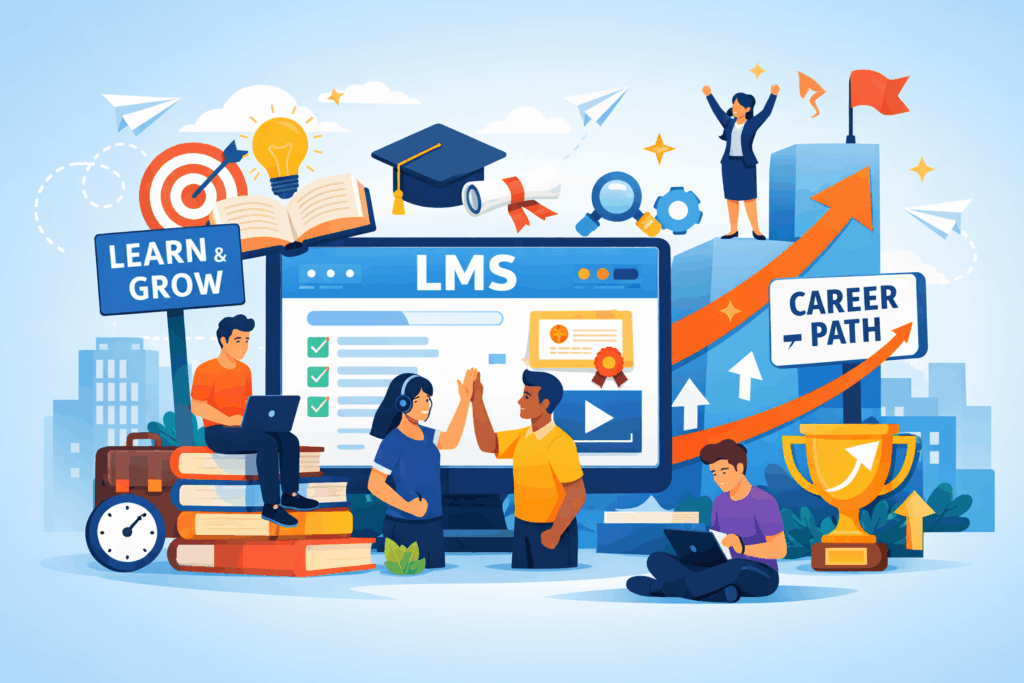
Turnover is typically a growth problem. When employees can’t see a future at your company, they start looking somewhere else. The fastest way to change that is to build a workplace where people can improve, advance, and feel proud of what they are becoming. Training is one of the most reliable ways to do it, and a Learning Management System (LMS) makes training consistent, measurable, and scalable.
Companies that treat learning as a business strategy tend to keep people longer. Gallup has found that organizations investing strategically in employee development are twice as likely to retain their employees. And LinkedIn research widely cited in its Workplace Learning reports shows that 94% of employees say they would stay longer at a company that invests in their learning and development.
An LMS is one of the best ways to operationalize that promise of growth.
LMS Training changes the employee experience in three key ways:
1) Training creates confidence, and confidence creates staying power
When employees have the skills to do their jobs well, stress drops and performance rises. When they don’t, frustration builds, mistakes increase, and attrition becomes more likely.
2) Training signals investment
Employees interpret training as a message. “This company sees potential in me.” That’s why the 94% LinkedIn statistic matters so much. Employees equate development with commitment.
3) Training turns a job into a path
Career growth is a sequence of skills, milestones, and clear next steps. Training provides those steps. An LMS makes them visible.
What an LMS Does That Ad Hoc Training Cannot
Without an LMS, training is usually scattered.
It lives in documents, slide decks, tribal knowledge, and one time sessions that are hard to repeat. That creates inconsistency across managers, locations, and teams. Employees feel the gap, especially new hires.
An LMS fixes the core problems that drive early turnover:
Centralization
Employees have one place to go for onboarding, role training, refreshers, and advancement tracks. That reduces confusion and increases adoption because learning is easy to access.
Consistency and fairness
Every employee gets the same baseline training, which improves performance and reduces the perception that growth depends on who your manager is.
Visibility
Employees can see what’s available, what’s next, and how to progress. That’s how you turn “maybe there’s a future here” into “I know exactly what I’m working toward.”
Measurement
Completion, competency, and progress can be tracked. That lets leaders spot gaps early and coach proactively.
The Retention Lift: What the Research Says About LMS Platforms
There is strong, credible evidence that learning management systems and learning culture materially improve retention.
- 94% of employees say they would stay longer if a company invested in their learning and development.
- Deloitte has reported that organizations with a strong learning culture can see engagement and retention rates 30% to 50% higher.
- Gallup reports that organizations making strategic investments in employee development are twice as likely to retain employees.
A well implemented LMS is one of the most practical ways to build that learning culture because it makes development repeatable, trackable, and easy to scale.
How an LMS Reduces Turnover in Real Life
Better onboarding that prevents early exits
Many companies lose employees in the first 30 to 90 days because new hires feel lost. An LMS reduces that risk with structured onboarding paths that cover:
- Role expectations and success metrics
- Systems and process training
- Product and customer knowledge
- Culture and values
- Clear milestones for the first week, first month, and first quarter
When employees know what success looks like and how to reach it, they are far more likely to stay.
Upskilling that keeps high performers engaged
High performers leave when growth is slow. An LMS helps you offer skill development that keeps ambitious employees engaged:
- Advanced training paths
- Certifications and micro credentials
- Cross training into other departments
- Leadership development tracks
This supports internal mobility, which is one of the strongest retention tools you can build because employees don’t have to leave to level up.
Clear advancement paths that make careers feel real
This is the big one!
When employees can see a pathway from their current role to the next, the job stops feeling like a dead end. Even if promotions are not immediate, progress is.
A strong LMS makes advancement feel tangible through:
- Role based learning paths aligned to promotions
- Skill matrices that show what to learn next
- Checkpoints and assessments that confirm readiness
- Visibility into career options inside the company
Best Practices for Implementing an LMS That Actually Moves Turnover
An LMS only reduces turnover when it’s implemented with intention. These are the practices that make the difference:
- Tie learning paths to promotions, raises, and role changes, so training leads somewhere real.
- Build manager involvement into the process, including check-ins and coaching moments.
- Use short, practical modules employees can complete during the flow of work.
- Recognize progress, not just completion, so learning feels rewarding.
- Use LMS data to identify risk, such as stalled progress, missed onboarding milestones, or low participation.
Training becomes even more effective when it’s paired with rewards and recognition. When learning milestones are acknowledged and progress is celebrated, training feels less like an obligation and more like an achievement. Recognizing course completion, skill mastery, and growth not only reinforces positive behavior but also adds a layer of fun to the work experience. Employees stay more engaged when learning is visible, appreciated, and connected to rewards, turning development into something people look forward to rather than something they have to get through.
The Bottom Line: Training Is Retention Strategy
If you want employees to stay, they need more than a paycheck. They need proof that they can grow with you.
Training provides that proof. An LMS platform delivers it consistently, at scale, and in a way employees can actually see and use.