
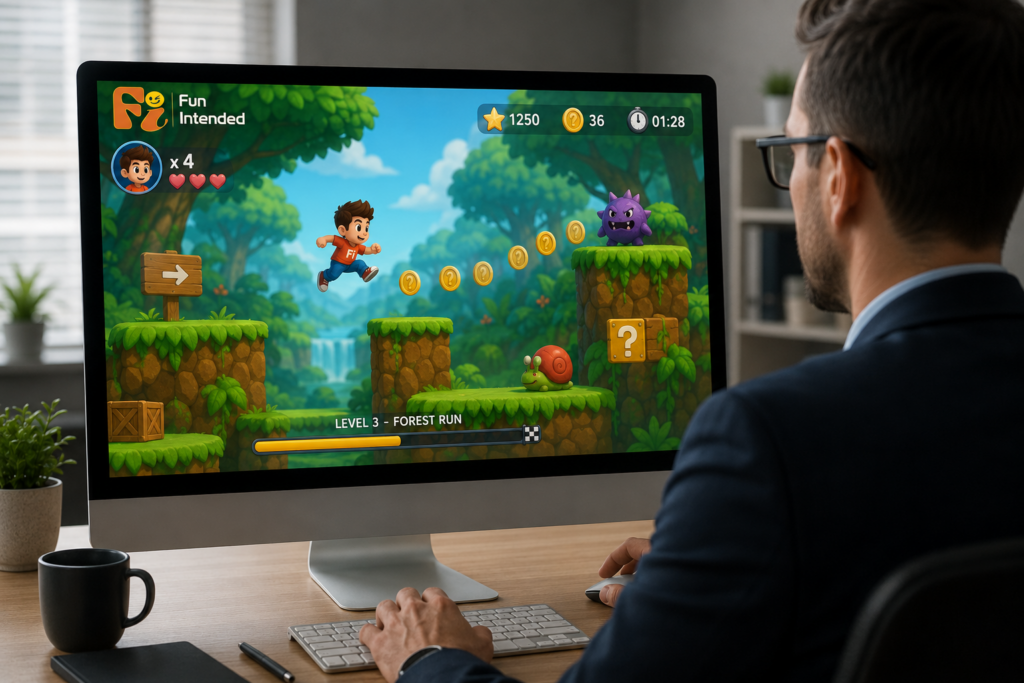
Before gamification had a name, the brain already understood it. The reward systems that make games compelling are the same systems that drive every motivated behavior in human life. There’s a science behind gamification. When you complete a task and receive recognition for it, your brain releases dopamine. That chemical signal creates a sense of satisfaction and a strong pull to repeat the behavior that triggered it. Dopamine is not simply a pleasure chemical. Its real power lies in anticipation. Research on the brain’s mesolimbic reward pathway shows that dopamine is released in the moment before you find out whether you succeeded, not after. That anticipatory surge is what keeps people focused and pushing forward.
Gamification borrows this mechanism deliberately. Points, progress bars, badges, and leaderboards all create low-stakes moments of anticipation that keep the dopamine loop active throughout the workday. The result is a brain that stays engaged with tasks it might otherwise approach with minimal effort.
Research from the Wharton Neuroscience Initiative confirms that gamification can lead to a 15% increase in productivity, driven largely by these neurological triggers. That number reflects real behavior change, not just better morale.
The Three Psychological Needs That The Science Behind Gamification Fills
Dopamine explains the short-term pull of gamification. Sustained engagement requires something deeper.
Psychologists Edward Deci and Richard Ryan developed Self-Determination Theory, which identifies three core psychological needs that drive intrinsic motivation: autonomy, competence, and relatedness. When all three needs are met, people become more engaged, more creative, and far less likely to burn out.
Autonomy is the need to feel in control of your own actions. Gamification supports this by giving employees meaningful choices, such as selecting tasks, choosing learning paths, or customizing how they earn recognition. When someone chooses to participate rather than being required to, their motivation increases substantially.
Competence is the need to feel capable and to see growth. Progress tracking, level-ups, and instant feedback satisfy this need by making skill development visible. Employees who can see themselves improving stay motivated longer than those who feel like their effort disappears into a void.
Relatedness is the need to feel connected to others. Leaderboards, team challenges, and peer recognition tap into this need directly. Workplace research grounded in SDT shows that employees whose needs for autonomy, competence, and relatedness are met show higher engagement, greater creativity, lower burnout, and reduced turnover.
How The Science Behind Gamification Helps Employees Learn Faster
Training is one of the areas where gamification produces the most dramatic results, and the neuroscience explains why.
Learning a new skill requires memory consolidation, which is the process of moving information from short-term experience into long-term retention. Dopamine release in the hippocampus, triggered by game mechanics like timed challenges or reward moments, actively supports that consolidation process. The anticipation created by a gamified quiz or a countdown timer does not just make learning feel more engaging. It physically helps the brain encode what was just experienced.
Studies on gamified learning have found that gamification can boost retention rates by up to 80% compared with traditional instruction methods. E-learning courses with gamified elements see a 90% completion rate, compared to just 25% without gamification. Employees also retain 22% more information when trained using gamified solutions.
Those are not marginal improvements. They represent the difference between a training investment that sticks and one that employees forget by Friday afternoon.
Why Gamification Builds Efficiency Over Time
Motivation gets employees started. Efficiency is what happens when motivated behavior becomes habit.
Gamification drives efficiency through a mechanism called repetition reinforcement. When an action generates dopamine, the brain begins to encode that action as a positive behavior and builds a desire to repeat it. Over time, that repeated behavior stops requiring conscious effort and becomes part of how someone naturally approaches their work.
This is why gamification improves performance even after the initial novelty wears off. Employees who earn recognition for completing tasks accurately and on time begin to internalize accuracy and timeliness as part of their identity. The game mechanics move from external motivators to internal standards.
Intrinsic motivation, which is motivation that comes from within rather than from rewards, is more durable than external pressure. SmartBrief’s analysis of dopamine-driven gamification notes that pairing intrinsic motivation with dopamine-promoting game elements creates sustainable outcomes. Extrinsic rewards start the engine. Intrinsic motivation keeps it running.
Focus, Flow, and the Gamification Connection
One of the most underappreciated benefits of gamification is its effect on focus. Distraction is expensive in the modern workplace. Every interruption costs time, and restoring deep focus after a distraction can take more than 20 minutes.
Gamification creates what researchers call a flow state, which is a condition of deep focus where a person is fully absorbed in a task and performing at their best. Flow happens when challenge and skill are balanced. The task is hard enough to require full attention but not so hard that it triggers anxiety.
Well-designed gamification constantly calibrates this balance. As an employee’s skill grows, the game adjusts the challenge upward. That moving target keeps people in the zone rather than drifting toward boredom or overwhelm. The continuous feedback loops built into gamified systems, points updating in real time, progress bars filling, badges appearing, all give the brain the signals it needs to stay anchored to the task at hand.
Growth Engineering’s neuroscience research on gamification confirms that continuous, immediate, and variable rewards keep the dopamine loop active, ensuring learners persist through difficult material and employees stay engaged through demanding projects.
What the Science Behind Gamification Means for Your Team
Understanding the science is useful. Applying it is what moves the needle.
The practical implication is that gamification works best when it is built around the three SDT needs rather than layered on top of a broken work environment. Points and badges added to a culture where employees feel unseen will not fix the underlying problem. They need a foundation of real recognition, meaningful work, and visible growth.
When that foundation exists, gamification amplifies everything. It accelerates learning, deepens focus, builds habits of efficiency, and creates the kind of intrinsic motivation that no performance review can manufacture. The brain is already wired for this. A well-designed engagement platform gives your team the environment that lets that wiring do its best work.
Become a Beta Tester for Fun Intended and Save 75%
Fun Intended is building an engagement platform designed around the science above, with gamification, recognition, and rewards working together to keep your team motivated, focused, and growing.
Join the beta program today and get 75% off access to the full platform. Help shape the product, get early access to every feature, and be part of a community rethinking what employee engagement looks like.