
Here’s a scenario that plays out in organizations every day. The annual employee engagement survey goes out in November. Results come back in January. Leadership reviews the data, builds a PowerPoint, shares some highlights with the team in February, and puts together an action plan that gets half-implemented by April. Meanwhile, three of your best people left in December.
That gap between when something goes wrong and when your measurement system catches it is one of the most expensive problems in workforce management today. Disengagement cost the global economy $438 billion in 2024, and a meaningful portion of that loss came from organizations that were relying on a once-a-year snapshot to understand something that changes week to week.
The annual survey is not useless. But it cannot carry the full weight of your engagement measurement strategy on its own. Here is how to build something better. Here’s how to measure the annual employee survey and create actions to avoid turnover.
The Real Problem With Annual Surveys
Before looking at what to add, it is worth being honest about why annual surveys fall short on their own.
The first problem is timing. A once-a-year survey creates a 3 to 6 month lag between identifying a problem and being able to act on it. In that window, disengaged employees are already looking for other jobs, already mentally checked out, and already influencing the people around them. By the time the survey data reaches a manager’s desk, the problem it was designed to catch has compounded.
The second problem is context collapse. An annual survey captures how employees feel on the specific day they fill it out. If an employee is having a week full of big wins, they will fill their survey with positive feelings even if that enthusiasm is not the norm. If they are having a rough week, the opposite happens. The data reflects a moment, not a pattern.
The third problem is what happens after. Many organizations conduct engagement surveys and then struggle to act on the results quickly enough for employees to feel the difference. When employees see no visible response to their feedback, survey participation drops in future cycles and trust in the process erodes. Organizations that act quickly on survey feedback consistently outperform those that rely on annual, static engagement cycles.
None of this means you should stop running annual surveys. It means you need to build a broader measurement system around them.
How to Measure the Annual Employee Survey: A Layered Approach
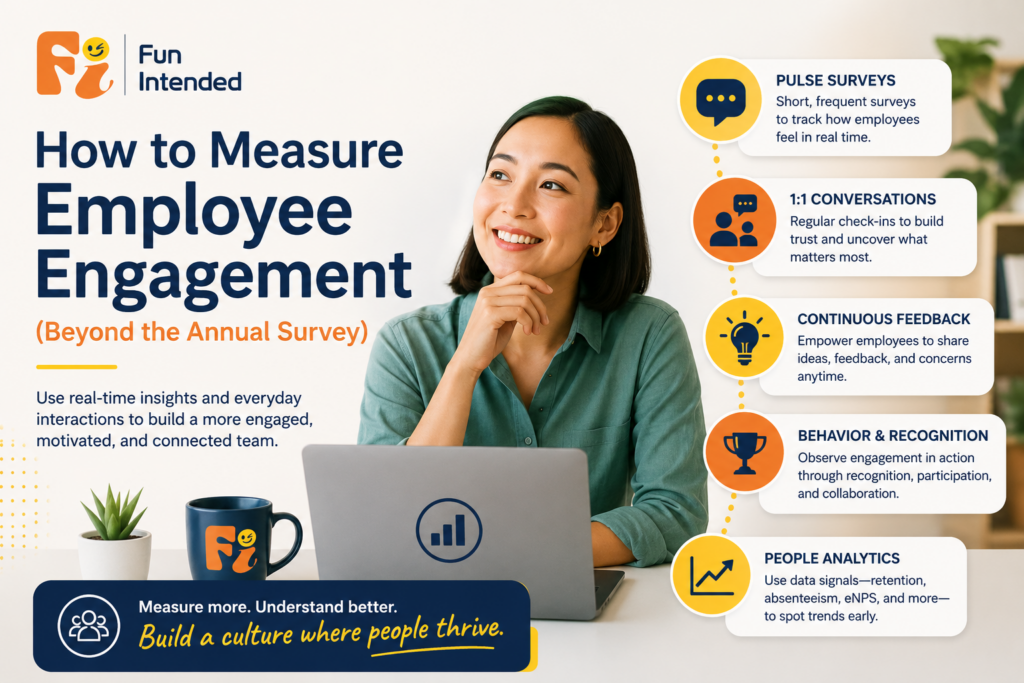
Effective engagement measurement combines multiple signals, some gathered through direct feedback and some observed through behavioral data. The goal is to create a picture that is both real-time and contextually rich enough to act on.
Pulse Surveys: Frequent, Focused, and Fast
The most natural complement to an annual survey is a pulse survey: a short, targeted check-in distributed weekly, monthly, or quarterly, depending on your organization’s size and pace of change.
Pulse surveys run quarterly alongside annual engagement surveys give teams the most actionable data to improve employee retention and workplace culture. Where an annual survey asks broad questions across many domains, a pulse survey focuses on a single theme. How supported do you feel by your manager this week? How clear are your priorities right now? Do you feel recognized for your contributions?
The value of pulse surveys is speed. Issues that would sit undetected for eleven months on an annual cycle can surface and get addressed within weeks. And because they are short, employees are far more likely to complete them honestly rather than rushing through a 60-question census survey in the final minutes of a workday.
One important caveat: more surveys are not always better. Increasing survey frequency to four or more times per year can significantly increase non-response bias and reduce the quality of insights. The goal is not to bombard employees with requests for feedback. It is to create a regular, lightweight rhythm that keeps your finger on the pulse without survey fatigue setting in.
Stay Interviews: The Conversation Annual Surveys Cannot Have
A stay interview is exactly what it sounds like: a one-on-one conversation with a current employee focused on what is keeping them at the organization and what might eventually push them to leave.
Unlike exit interviews, which gather information after the fact from someone who has already decided to go, stay interviews are proactive. They surface issues while there is still time to address them and signal to employees that leadership is genuinely interested in their experience, not just their output.
Effective engagement measurement combines qualitative data from stay interviews and pulse surveys with quantitative data like turnover and absenteeism rates. Stay interviews contribute the kind of contextual, nuanced insight that a multiple-choice survey question simply cannot produce. They give you the “why” behind the numbers.
Done well, stay interviews are also a recognition tool. When a manager sits down with an employee specifically to understand what makes them want to stay, it communicates investment in that person’s experience and future. That conversation itself can move the needle on engagement.
Behavioral Data: What the Numbers Are Already Telling You
You do not always need a survey to know engagement is slipping. HR teams can tie engagement directly to business metrics like absenteeism, productivity, and turnover, and those metrics are often signaling problems months before an employee hands in their notice.
A few of the most telling indicators:
Absenteeism rates. Gallup data shows that top-quartile engagement teams experience 81% lower absenteeism than bottom-quartile teams. If absenteeism in a specific team or department is rising, that is an engagement signal worth investigating before it escalates.
Participation in recognition programs. When employees stop nominating peers, stop responding to recognition, or stop engaging with team programs, it often reflects a broader withdrawal from the culture. Tracking participation rates in recognition platforms over time is a direct window into engagement health.
Internal mobility and promotion rates. Employees who see a future at your organization pursue development opportunities, apply for internal roles, and engage with training. A drop in internal mobility can indicate that employees have stopped believing in their path forward.
Voluntary turnover trends. Turnover is a lagging indicator, meaning by the time it shows up in your data, disengagement has been building for a while. But tracking voluntary turnover by team, tenure, and role can help you identify where the engagement gaps are deepest so you can prioritize resources accordingly.
Spotting early warning signs like missed goals or declining participation gives leaders the chance to act fast, re-engage their teams, and protect long-term performance. The organizations that do this well are not reacting to turnover. They are preventing it.
Feedback Channels That Are Always Open
One of the most underleveraged engagement measurement tools is also one of the simplest: a consistent, accessible channel for employees to share feedback between formal survey cycles.
A digital suggestion box, an open-door policy with a real process behind it, or a regular forum where employees can surface ideas and concerns all give you signal that you would otherwise miss. More importantly, when employees see that feedback leads to visible action, trust in leadership grows.
This was one of the foundational elements of the transformation Fun Intended led at TAS United, a Texas-based call center that reduced turnover by 82% in 12 months. A digital feedback channel was implemented alongside a monthly newsletter and structured communication infrastructure, giving employees a consistent way to be heard between formal survey cycles. Leadership acted on what they heard, and that visible responsiveness was a core driver of the trust that ultimately kept people around.
Turning Data Into Action: The Step Most Organizations Skip
Here is the uncomfortable truth about engagement measurement: the data is only as valuable as what you do with it.
22% of organizations lack analytics or measurement tools to track employee engagement at all. But an equally significant problem affects organizations that do have the data and still fail to act on it consistently. Employees who take a survey and never see any response become less likely to engage with the next one, and less likely to believe that their feedback matters.
The standard to hold yourself to is simple: every time you collect feedback, communicate back what you heard and what you are doing about it. This does not require fixing everything immediately. It requires transparency about what you found, what you are prioritizing, and what employees can expect.
This is where a connected engagement strategy makes all the difference. Measurement without an action infrastructure is just data collection. When survey insights feed directly into recognition programs, training and development pathways, and mentorship structures, the feedback loop closes. Employees see that what they share leads to something real, and engagement in the measurement process itself improves as a result.
What a Complete Engagement Measurement System Looks Like
Putting it all together, a measurement strategy that actually works combines several layers operating at different frequencies:
An annual survey provides the comprehensive, organization-wide benchmark. Quarterly or monthly pulse surveys track sentiment in near real time and surface emerging issues before they escalate. Stay interviews give individual employees a voice and provide the qualitative depth surveys cannot. Behavioral data from absenteeism, participation, and internal mobility fills in the picture with objective signals that do not depend on employees self-reporting. And always-open feedback channels ensure there is no gap between survey cycles where problems can quietly grow.
None of these tools work in isolation. The value comes from using them together as a connected system, where each source of signal informs the others and all of it feeds into a visible, consistent response from leadership.
Where to Start
If your current engagement measurement strategy is primarily an annual survey, the most impactful first step is adding one layer of real-time feedback, whether that is a quarterly pulse survey, a round of stay interviews, or simply a consistent feedback channel that employees trust is actually being read.
The goal is not to measure engagement perfectly from day one. It is to close the gap between when disengagement starts and when your organization finds out about it.
Fun Intended’s employee engagement consulting is built around helping organizations build exactly this kind of connected listening infrastructure, one that catches problems early, supports managers in responding, and gives employees the experience of being genuinely heard.
Measurement is not the end goal. A workforce that feels engaged, recognized, and invested in is. The right measurement system just helps you get there faster.
Want help building an engagement measurement strategy that gives you real-time signal instead of annual snapshots? Get in touch with Fun Intended to start the conversation.